06 May, 2023

THE PHARAOH OF EXODUS


It was Moses, not Jeremiah, who mentioned the pharaoh of Israelite exodus.


"Therefore they did set over them taskmasters to afflict them with their burdens. And they built for Pharaoh treasure cities, 

Pithom

and Raamses.
 
And they made their lives bitter with hard bondage, in morter, and in 

brick,

and in all manner of service in the field: all their service, wherein they made them serve, was with rigour." -Exodus 1:11,14
 

 Moses relates his time during the reign of a pharaoh who built Pithom as store-city, which according to Encyclopaedia Britannica was founded by king Rameses II the Great (1279-1213 BCE). The basis that the Pithom was founded by Rameses is the pharaoh's positive declaration: " I built Pithom..." in an inscription discovered in 1883 by Edouard Nashville 13 kilometers (8 miles) from the east of Tell el-Retabeh. 
Moses added information about this city when he reported that there were shortages of straw to make bricks and that Hebrews were the laborers in this project (Exo. 5:7-20).


The scientists of Polish-Slovac Archaeological Mission in cooperation with Slovac Academy of Sciences, Institute of Archaeology, Polish Centre of Mediterranean Archaeology, and Aigyptos Foundation confirmed the two claims of Moses: Pithom built by the pharaoh who built Raamses city and shortages of straw (ingredient to make bricks stronger). They discovered there a cartouche of king Rameses II and two inscriptions bearing the city's name "Pithom" or temple of Atum. This was the first fortress in Tell el-Retabeh, and in Septuagint it is known as "πόλεις ὀχυραί" (poleis ochurai: "fortified city"). This city, with its 6-meter thick wall, was having walls made of mud-bricks with straw. Scientists discovered that the construction workers were not Egyptians but Semitic, particularly the descendants of Hyksos, and found out that some of the bricks were having fewer straw, showing us that there were shortages of straw in the vicinity.
These accuracies of Moses are rejected by atheists on the ground that, based on their feelings, Pithom of the Bible is not the Pithom built by king Rameses II in the 13th century BCE but the Pithom in Tell el-Maskhutah built around 7th century BCE. 
 Israel Finkelstein, well known archaeologist minimalist,  believes the Exodus account was modeled after pharaoh Necho II in the late-7th century BCE. 

This erroneous asserted belief is corrected by the fact that Rameses II built Pithom in Tell el-Retabeh in Wadi Tumilat and the city was abandoned till another pharaoh (likely Necho II) rebuilt another Pithom to Tell el-Maskhutah and transfered the materials of Rameses' Pithom to that new location.
Nevertheless, king Rameses II was the founder of Pithom. There was no Pithom store-city in 1446 BCE, neither there was Pithom built with bricks made of straw and mud in 1450 BCE near Succoth or Avaris. 

Atheists and their adherents rejected the claim of Moses that the pharaoh who built Pithom was the same pharaoh who built the city Raamses. They rejected Pithom of Rameses as the biblical Pithom. And worst, they even rejected Pithom, because there was no Pithom city in 1446 BCE.

Moses seems to clarify too that the pharaoh during his time was nearer to the time of the death of Joseph, the son of Jacob (Israel).


"And all the souls that came out of the loins of Jacob were 70 heads: for Joseph was in Egypt already. And

Joseph died,

and all his brothers, and all that generation. Now there arose up 

a new king over Egypt,

who did not know Joseph." -Exodus 1:5-6,8

Joseph (1486-1376 BCE) died few decades before Rameses II was born in 1303 BCE. Rameses II's father claimed to have started a new dynasty of the kingdom, and Manetho thought that indeed Seti founded a dynasty. And in Exodus 1:8 such new kingdom is likely implied. New dynasty was founded by king Rameses I, the father of Seti and the grandfather of Rameses II. Both of these kings were involved in developing Qantir, 2 kilometers distant from Avaris. Seti I built a palace in Qantir, and after his death his successor made that area the capital of Egypt and renamed it " Per-Ramesesu, Aa-nakhtu" ("Domain of Rameses, Great in Victory"), which was named by Moses as "Raamses" and described as a treasure city.
The city became known with the name "Rameses," and in Merneptah's reign (1211 BCE) the name "Rameses" was popularly used for a region in the eastern part of Delta Nile, Egypt. Moses too, rode on that popularity that he even used the toponym "Rameses" when he identified the location of Goshen in relation to the transfer of Jacob to Egypt during Joseph's time at Heliopolis.
The toponym "Rameses" was very popular that even Moses used it when he wrote the original of the book of "Genesis." 

"And Joseph placed his father and his brethren, and gave them a possession in the land of Egypt, in the best of the land, in the 

land of Rameses,

as Pharaoh had commanded." -Genesis 47:11 

Many doubters and unbelievers claim that it was not Moses who mentioned "Rameses" but some latter scribes. This doubtful teaching is corrected when the Bible has positively identified that it was Moses who wrote the exodus mentioning "Rameses."


Numbers 33:2-8

"And Moses wrote their exits according to their journeys by the commandment of YHWH: and these are their journeys according to their goings out: 
And they took their exodus from 

Rameses

on the 15th day of the 1st month; on the day after the Passover the children of Israel went out with an high hand in the sight of all the Egyptians. For the Egyptians buried all their firstborn, who YHWH had smitten among them: upon their gods also YHWH executed judgments. 
And the children of Israel removed from Rameses, and camped at 

Succoth.
 
And they left Succoth, and encamped at Etham, which is in the edge of the wilderness. And they removed from 

Etham,

and turned again unto Pihahiroth, which is on front of 

Baalzephon:

and they camped on front of 

Migdol.
 
And they departed from before 

Pihahiroth,

and passed through the midst of 

ha-yam
[the sea]

into the wilderness, and went 3 days' journey in the wilderness of Etham, and camped at Marah." -Numbers 33:2-8


Anti-Moses and anti-Bible thinkers rejected almost all of the toponyms here on the ground that most of them were not in existence in 1446 BCE. 

Moses named the 13th century BCE toponyms, and because of this the anti-Moses writers are accusing the book of Exodus, Numbers and of Deuteronomy with anachronism with regards to the name place "Rameses."

Migdol in this passage is what the Migdol of king Seti I (1290-1279 BCE) refered to, as the description is identical to what Papyrus Anastasi V, sheet 9, 20.1- 20.6 has been describing, whereas "wilderness of Etham" is also called in Exodus 15:22  "wilderness of Shur" (which is going to Negeb, south of Judah).

Baalzephon was a place mentioned in Papyrus Sallier around 1225 BCE when Rameses II was the pharaoh. 

Pihahiroth, on the other hand, is mentioned too by the scribe of king Merneptah in circa 1211 BCE in Papyrus Anastasi III, 2:8-3:3. The toponym is likely an Hebrized form of "pr hwt-hrt," apparently from 

"pr hwt-w'rt"
 ("precinct of Avaris").

 The Hebrized form appears to mean "mouth of the canal [of Avaris]."

Succoth was Egyptianized into "Tjeku," and was also described as a place of foreigners. The toponym "Succoth" is Hebrew, and this may mean that the foreigners living there were Hebrews, known to the time of king Rameses II as "Apiru" ("Hapiru," or "Habiru"). 

Ha-yam ["the sea"] in the midst of which Israelites had walked dryshod is clearly identified by Moses with the name "yam suph," known in Papyrus Anastasi III, 2:8-3:3 as "pe yam" ("the sea") and "tufy" ("reeds"). Moses borrowed the Egyptian toponym "Tufy" and made it "Suf" or "Suph," meaning "reeds" or water plants. In Exodus 2:3 suph is mentioned located "by the edge of the Nile river [ha-y'or]." 


"So Moses brought Israel from the 

yam suph
[sea of reeds],

and they went out into the

wilderness of Shur;

and they went 3 days in the wilderness, and found no water. And when they came to Marah, they could not drink of the waters of Marah, for they were bitter: therefore the name of it was called Marah." -Exodus 15:22-23


Yam Suph or Reeds' Sea is in Egypt, particularly near the Precinct of Avaris in Rameses, before going to the high way of the wilderness of Shur. This same place is clearly located in Rameses in Egypt by the Papyrus Anastasi III.
Therefore, the sea where Israel passed on dryshod in its midst is in Egypt, not in the Gulf of Aqaba, nor in Saudi Arabia.
Pihahiroth, the neighborhood of that yam suph, was in Egypt.
Migdol of Seti was in Egypt.
Etham was in Egypt.
Succoth was in Egypt. 
Baalzephon was in Egypt.


And therefore, yam suph (Reeds' Sea) is in Egypt, not in Saudi Arabia nor in Aqaba.


If we will use the toponym "Baalzephon" as a guide to determine the timeline of exodus, then the departure of Israel from Rameses was near 1225 BCE, the time when Papyrus Sallier IV, 1:6 was written. And to be exact, the firstborn son of the pharaoh that died near 1225 BCE was no other but the crown prince Ramesses B junior, who died in 1228 BCE, when Moses was 80 years old (Exo. 7:7). 


HOW TO DETERMINE THE EXODUS' PHARAOH

The pharaoh was easily determined, because the report of Moses about "giants" (to be specific, Joshua's report: giant Sheshai of Arba) is confirmed by king Rameses II and Egyptian army scribe Hori (fl. 1207-1160? BCE); the report of Moses about being recognized on fronts of the pharaoh's servants is verified by king Rameses II in the document now known "Stele of Mose." Even the major arrangements of Moses' YHWH's tabernacle is resembling of what king Rameses II's camp had been built. Moses gives the period that exodus had taken place and it was when they "found no water" at Marah, and king Rameses II partly corroborated it that during the Late Bronze Age Collapse, famine was hitting Hittite land and its king, Tudhaliya IV, was obligated to build 10 dams for water supply and that Rameses II's successor (Merneptah) anticipating, had been preparing for the drought when he made several wells named "Wells of Mer-neptah," which Joshua called "Well of Mei-Nephtoah." (Josh.15:9, 18:15).


 Joshua's report about Kishon of Jabin is in the Karnak Topographical List 23.21 of king Rameses II. 

1) Giants:

Numbers 13:22,26-28,33

"And they ascended by Negeb, and came unto Hebron [Arba]; where Ahiman

Sheshai,

and Talmai, the sons of Anak, were. (Now Hebron was built 7 years before Zoan in Egypt.) 
And they went and came to Moses, and to Aaron, and to all the congregation of the children of Israel, unto the wilderness of Paran, to Kadesh; and brought back word unto them, and unto all the congregation, and shewed them the fruit of the land. And they told him, and said, We came unto the land whither you sent us, and surely it flows with milk and honey; and this is the fruit of it. Nevertheless the people be strong that dwell in the land, and the cities are walled, and very great: and moreover we saw the children of Anak there. 
And there we saw the giants,... who come of the Nefilim: and we were in our own sight as grasshoppers, and so we were in their sight." -Numbers 13:22,26-28,33
 
"And Judah went against the Canaanites that dwelt in Hebron -now the name of Hebron before was city of Arba - and they slew Sheshai, and Ahiman, and Talmai." -Judges 1:10

"Whither shall we go up? our brethren have discouraged our heart, saying, The people is greater and 

taller than we;

the cities are great and walled up to heaven; and moreover we have seen the sons of the Anakims there." -Deuteronomy 1:28


According to Joshua 15:14, Sheshai were the sons or descendants of Anak. Egyptian Execration Texts between 1800 and 1630 BCE mention ly-Anaq ('people of Anak'), whose leader was Abi-Yamimu ("Father Emim"), whose descendants (Emim) were allies to Abraham (Genesis 14:5,12). Among the descendants of these Anakim where the giant Sheshai of Arba, known giant "Shasu" to king Rameses II. Rameses' army scribe Hori reported that the height of Shasu living in Hebron, north of Derbi or south east of Joffa, was between 7 or 9 feet. It was king Rameses II who also reported a tribe called "sh-sw w-r-b-r" ("Shasu of Arbar").
King Rameses II confirmed the existence of giant Shasu and even depicted them on his Kadesh Battle inscription.


2) Moses on front of the servants of pharaoh in Rameses.

"Speak now in the ears of the people, and let every man borrow of his neighbor, and every woman of her neighbor, jewels of 

silver,

and jewels of gold. 
And YHWH gave the people favor in the sight of the Egyptians. Moreover the 

man Moses

was very great in the land of Egypt, in the sight of 

Pharaoh's servants,

and in the sight of the people. And Moses said, 'Thus says YHWH, About midnight will I go out into the midst of Egypt: And all the firstborn in the land of Egypt shall die, from the Pharaoh's 

firstborn sitting upon his throne,

even unto the firstborn of the maidservant that is behind the mill; and all the firstborn of animals. And there shall be a great cry throughout all the land of Egypt, such as there was none like it, nor shall be like it any more.' " -Exodus 11:2-6


King Rameses II confirmed the biblical claim that Moses became famous on the sight of the pharaoh's servants after receiving silver and precious gifts from the palace. Rameses II even identified Moses as "beloved of Atum.
Atum was an Egyptianized "Amutu" ("Adamu," that is, "Adam"), the patriarch of Moses who was deified by the Egyptians around 2400 BCE.
The pharaoh even depicted Moses as a too much old great soldier. According to Exodus 7:7, Moses was 80 years old when he met the pharaoh. King Rameses held an especial day to give Moses silver and gifts from the palace, and acknowledgement as a great soldier, and given permission to have dominion over a certain group of people, as the compensation to his loyalty and favorable speech or talks about the pharaoh. This event took place in Pi-Rameses, or the city Raamses. The pharaoh, in effect, is trying to ask favor from the army, that they should imitate Moses for being loyal.

"Look, the soldier Moses has done what I as his Majesty asks favor for... How excellent is what he has done for me, very great!" king Rameses II told to the army. And the good thing which Moses has done, according to the pharaoh, has caused him to be pleased.
The army celebrated Moses.
According to Moses, the firstborn son was sitting on the throne of the pharaoh. The occasion that the firstborn son could sit upon his father's throne is when the pharaoh has reached heb sed (jubilee festival), that is, when the pharaoh was in or more than 30 years in service and when busy performing the function as a ritually god of Egypt. King Rameses II was serious in his stand to be recognized as one of the Egyptian gods, and in fact he made it very conspicuous, and one of these was to let his crown prince, firstborn son Ramesses B junior, sit on his throne in his behalf. Needless to say, prince Rameses B junior was the de facto pharaoh (the acting king of Egypt) under the sight of his father (the real pharaoh). 
Unfortunately, this firstborn son sitting upon his throne died in 1229 BCE. He was the crown prince when king Rameses the Great became an Egyptian god in around 1250 BCE and when departure of Israel from Rameses took place in 1228 BCE. No firstborn son succeeded king Rameses II, because all of his firstborn sons died one by one before he died, and Rameses made the largest tomb in Egypt to bury them there. It was his 13th son, Merneptah, who successfully succeeded on his throne.

Because of the untoward incident, the death of the firstborn son, the pharaoh of Rameses city let Israel wonder going to wilderness of Makhtesh Ramon, near Kharu (Horite state of Seir). 
The Stele of Mose, that king Rameses was commissioned to be erected, was tried to be erased, and the report about Mohy (the soldier behind the successes of king Seti I) was deliberately erased by king Rameses II.


Ipuwer, an Egyptian 19th dynasty scribe, wrote during the reign of king Rameses II (c.1229 BCE), that Egypt was devastated by plagues, and he said there is blood everywhere, that the river is blood, every man is thirsting for water (Israelites complained the same problem to Moses), trees are felled, branches are stripped, grain is lacking in all sides, birds find neither fruits nor herbs, groaning is throughout the land, mingled with laments, many were buried in river, stream became graveyard, everywhere is him who put his brother on the ground, all is ruin, the land was without light, and gold, silver lapis lazuli, malachite, carnelian and bronze were necklaced by the female slaves. All of these are also reported by Moses before they leave Rameses in 1229 BCE, after the death of the firstborn son sitting on the throne of the pharaoh. 

According to the New Testament, the promise of God to Abraham was confirmed after 430 years. It was around 1659 BCE when Abram lived in Egypt, and till the last day of Israel in Egypt in 1228 BCE, there was a space of 430 years.
Exodus 12:40-41 was understood by ancient Hebrews, including apostle Paul, as:

"Now the sojourning of all armies of YHWH, who dwelt in Egypt, 30 years and 400 years. 
And it came to pass at the end of the 430 years, even the selfsame day it came to pass, that all the

children of Israel 

went out from the earth of Egypt." -Exodus 12:37,40-41

Ancient Hebrews understood it to mean, from the time of Abram's living in Egypt till the time of departure of Israel is 430 years. For them, it was Israel that left Egypt in the last day of that 430 years. 

Apostle Paul makes it simple this way:

"Now to Abraham and his seed were the promises made... 
 ... that the covenant, that was confirmed ... 430 years after, cannot disannul, that it should make the promise of none effect. 
... God gave it to Abraham by promise." -Galatians 3:16-18

New Testament connected this "430 years" to the covenant of God to Abram which was fulfilled during the time of exodus of Israel from Rameses.


"And the children of Israel journeyed from Rameses to Succoth, about 600 elef foot-persons, beside children. 
Now the sojourning of the children of Israel, who dwelt in Egypt, 30 years and 400 years. 
And it came to pass at the end of the 430 years, even the selfsame day it came to pass, that all the

  צִבְא֥וֹת   [siboth]
armies

of YHWH went out from the earth of Egypt." -Exodus 12:37,40-41
 
Modern readers, particularly those anti-Bible, connected that 430 years not to the covenant to Abraham but to the arrival of Jacob in Egypt, and in this the error comes in.
Why error?

Because the Bible clearly says "430 years" is connected to Abraham. Second, the fulfilment happened when Israel left Rameses.

Because of this intricate calculation, many modern readers have their 

EPIC FAIL,

particularly in coercing Amenhotep II as the pharaoh of EXODUS by believing that exodus occurred in 1446 BCE, while Amenhotep II took the throne in 1450 or 1454 BCE (High Chronology) or 1426 BCE (Low Chronology), which means Amenhotep II was not one of the Egyptian gods being referred to by Moses to be affected by the death of the firstborn son in Numbers 33:2-5, because to be ritually become a state god, the pharaoh must at least have served 30 years on throne. Another thing, there was no pharaoh's firstborn son died in 1446 BCE.
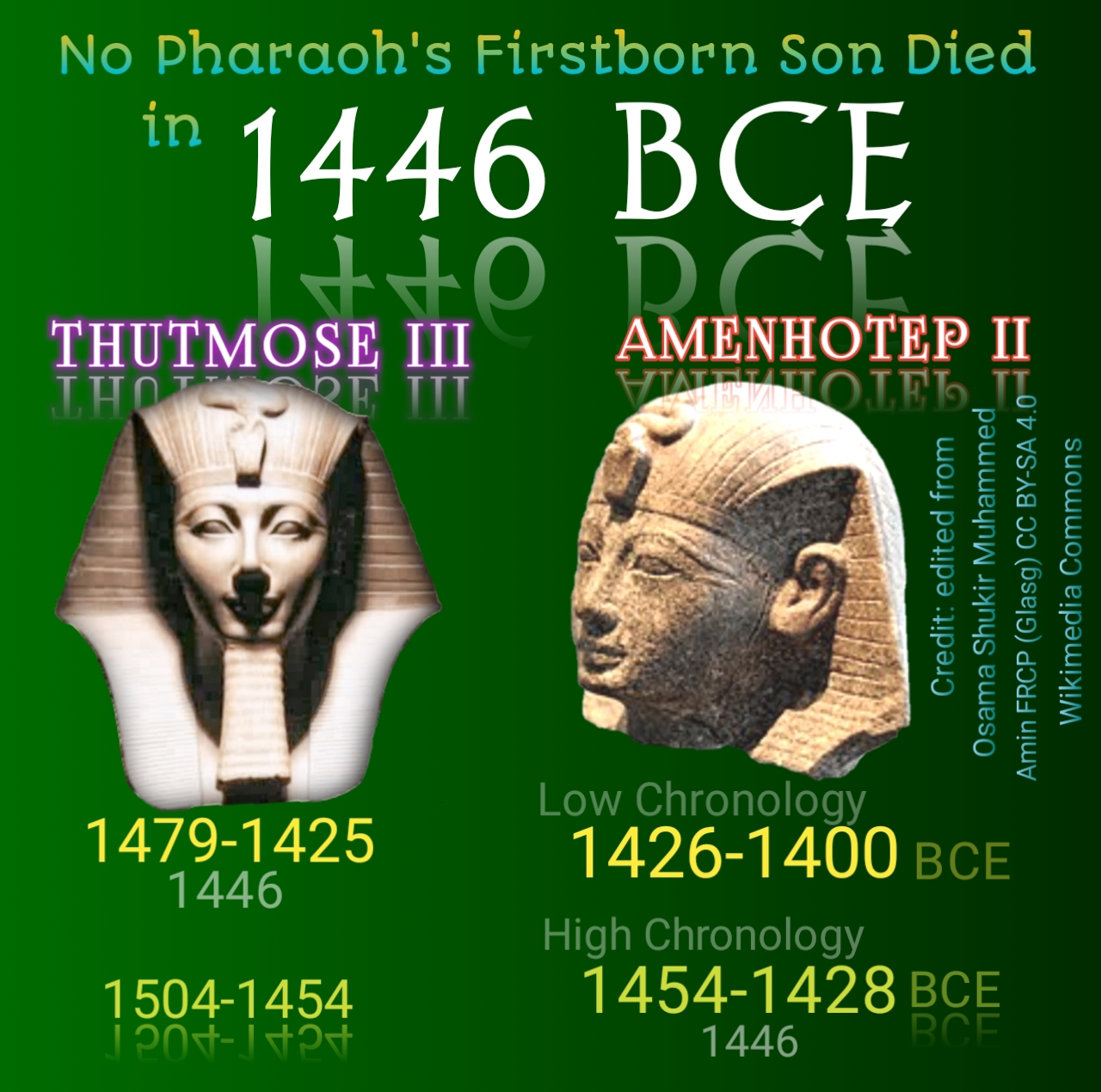

Complicating these fails is the historical fact that Amenhotep II did not free but he captured 101,000 captives in his Year 9 in the 3rd military campaign (around 1418 BCE) from Syria-Palestine to Egypt, opposite to the claim that he had freed Hebrews from Egypt to Syria-Palestine in 1446 BCE. And his vizier Rekhmire proves that indeed Semitic men were enslaved in Egypt to make bricks. Amenhotep II became a state god if he celebrated his first heb sed (jubilee festival) in circa 1396 BCE so that his title "Amenhotep II, the god who ruled in Heliopolis" is too far late from the believed 1446 BCE Exodus. Moses clearly reported that the death of the pharaoh's firstborn son was a judgement against all Egyptian gods, the most affected was the pharaoh himself -implying that the king was one of the Egyptian gods - which does not fit with Amenhotep II who might have reached that status only in around 1420 or 1396 BCE, twenty six or 50 years late after the assumed 1446 BCE Exodus. But Amenhotep II did not celebrate his heb sed because he reigned only 26 years. Also, it is a fact that Amenhotep II was not the founder or builder of Avaris, but Moses clearly identified that a pharaoh built store-cities Pithom and Raamses. Besides, Avaris was not built during Amenhotep II's reign, rather Semitic people who lived there (in Stratum d/1 in Area F/I to Stratum c in Area H/I-VI) abandoned it as pottery could give date during his reign.


Additional to this epic fail, is when modern readers use the estimation of deacon Stephen as an exact counting.
Stephen rough estimate of the period of the judges is 450 years (Acts 7:20); he also estimated that Moses was full 40 years old when he visited his countrymen (Acts 7:23), although the book of Exodus does not give such age. 

Estimate is used to estimate and not to give exact date.
For example, in Exodus 12:37 it is estimated that there was 

around

600 elef

who initiated exodus. When Moses took the first census, the exact number is 598 elef.
The 600 is used because it was then a military unit. But Moses was careful in saying "about," to mean not exactly.

When the eyewitness talked about their exodus, he is very specific to tell that it was the departure from Rameses. And modern writers rejected this eyewitness' report, and coerce to connect 1Kings 6:1, which does not speak about departure "from Rameses."

An eyewitness' testimony:

Numbers 33:2-5

"And Moses wrote their journeys by the commandment of YHWH: and these are their journeys according to their goings out: 
And they departed 

from Rameses

on the 15th day of the 1st month; on the day after the passover the children of Israel went out with an high hand in the sight of all the Egyptians. 
For the Egyptians buried all their firstborn, which YHWH had smitten among them: upon their 

gods

also YHWH executed judgments. 
And the children of Israel removed 

from Rameses,

and pitched in Succoth." - 

Numbers 33:2-5


Not an eyewitness (but six hundred years later after the exodus):

"And it came to pass in the 480th year after the sons of Israel were come out of the land of Egypt, in the 4th year of Solomon's reign over Israel, in the month Zif, which is the second month, that he began to build the house of YHWH." -1Kings 6:1

This passage has no error. The error is when modern readers are trying to connect it to the departure of Israel from Rameses. And worst, anti-Bible thinkers rejected the report of Moses about the Exodus of Israel from Rameses.
If it has nothing to do with the departure of the children of Israel from Rameses, then to where it is connected?
The biblical answer is in the following passage:

Genesis 45:17,21,24-25

"And Pharaoh said unto Joseph, Say unto thy brethren, This do ye; lade your beasts, and go, get you unto the land of Canaan; And the 

children of Israel did so: ...
 
So he sent his brethren away, and they departed: ...
And they went up 

out of Egypt,

and came into the land of Canaan unto Jacob their father" -Genesis 45:17,21,24-25 (KJV)

If it's not having connection with the Israelite exodus from Rameses, then it is connected to the going out from Egypt of the children of Israel (Jacob) in 1449 BCE, during the Year 2 of a famine (Gen. 45:6,11).


In the scientific studies on the quantity of pollens in the southern Levant, we can notice the lesser number of pollen in around 1450, 1550's, 1660's, and fewest in 1859 BCE. These scientific findings are supported by the Bible as biblical report (Gen. 26:1,6) says there were famines during the days of Abraham (1660's BCE) and of Isaac (1550's BCE). 


Both science and the Bible are accurate in this respect. This only means that indeed there was famine in 1449 BCE, when the sons of Israel went up out of Egypt to Canaan to take their father Jacob. In the 480th year, king Solomon built the temple of YHWH in Jerusalem.

Needless to say, the Bible is accurate, and Moses has an accurate eyewitness account, that exodus happened when Israel left Rameses in 1228 BCE.

Manetho, the source of modern dynastic system determination and a Greek-speaking Egyptian priest, clearly named 

Rhampses (Rameses II),

Sethos (Seti),

Amenephthis (Merneptah), and

Rameses (Ramesses III)

as the pharaohs during the time of Moses, and Rhampses, according to him, has reigned 66 years. He published it in an official Egyptian History (Aegyptiaca) around 3rd century BCE, now preserved in Josephus' Against Apion 1.26
Both Moses (in the Bible) and Manetho are mentioning Rameses. Modern readers rejected their reports. And these rejecting Moses' report are anti-Moses writers. At one hand they claim as defenders of Moses, but on the other side they are claiming "Rameses" in Genesis, Exodus, and Numbers is not written by Moses but by latter or "future" scribes. When asked who were those "future" scribes, they could not name them, neither there is a biblical support that other scribes were the originators of the toponym "Rameses." Some are even boldly claiming that Moses did not write the original or 1st edition of the book of "Genesis."


"Prove all things; hold fast that which is good." - 1Thessalonians 5:21

"Beloved, believe not every spirit, but 

δοκιμάζετε
[dokimazete]
test

the spirits whether they are of God: because many false prophets are gone out into the world." -1John 4:1
 
"But sanctify the Lord God in your hearts: and 

be ready always

to give an answer

to every man that asketh you a reason of the hope that is in you with meekness and fear: 
Having a good conscience..." -1Peter 3:15-16


NOTES:

* Jeremiah: the book of "Kings" is believed to be have written by Jeremiah or most likely by Ezra. The writer was around 700 years distant from Moses' exodus.

*Pithom: from the Egyptian word "pr jtm" or "per-Atum," meaning "house of Atum," the city was intended to be the place of worship for Atum, a possibly Egyptianized  "Amutu," which is the Babylonian of "Adamu," the patriarch of king Hammurabi, Assyrians and Hebrews. King Rameses II might have considered that the foreigners in Succoth were descended or created by god Atum (Adam). The pharaoh boastfully announced: "I built Pithom in the east."
After him, his son and successor Merneptah, named it or another one as "Pithom of Merneptah." Then, during the time of pharaoh Necho II, another Pithom was built, but this time at 13 kilometers away from the original Pithom. The stretch of valley hence was known with "Tum" or "Atum," that ancient Arabians might have feminized the area's name as "Tumilat."
There was no Pithom in 1446 BCE or older.


*pharaoh founder of new dynasty was nearer to the death year of Joseph.
Moses knew that the pharaoh during his time was nearer to the death-year of Joseph because Moses was in the 4th generation from the dwelling of Jacob (Israel) in Egypt.

El Shaddai promised to Abram that his seed would be afflicted by Egypt within 400 hundred years, but in the 4th generation his descendants would come back to Canaan (Gen. 15:13-16).
Moses named who were those in the 4 generations.

1) Levi (1494-1356 BCE),
2) Kohath,
3) Amram,
4) Moses (1309-1189 BCE).

Levi was the brother of Joseph.
And this indeed shows that Joseph is near to the pharaoh during Moses' days.


* pharaoh built Pithom and Raamses:

It is clear in the Bible that what the pharaoh built was treasure-city "Raamses," for obvious reason that Avaris was founded by Amenemhat I (1991-1962 BCE) when there was not a single Israelite in existence, and later it was usurped by the Hyksos. The Hyksos who re-founded Avaris was not an Egyptian pharaoh, and therefore Moses is accurate in giving Rameses to be in his timeline, and modern writers are wrong in giving Avaris as the founded city of the Egyptian pharaoh during Moses' days. Besides, Avaris is 2 kilometers distant from Raamses.

And if Pihahiroth is an Hebrized form of "pr hwt-w'rt" ("house of Avaris"), then Moses is in effect distinguishing "Rameses" from "Avaris," that is, giving "Rameses" as a region where "Pihahiroth" belongs.

* visa:

Men passing in or out to the wall to go to Migdol of Seti near the wilderness of Shur must have authorization we called today visa. Their number and their belongings and the dates and hour of their arrival and/or departure were recorded by the guards and being sent to the officials. Moses reflected that practice when he wrote their journey from Rameses to wilderness of Shur. Since he had been given gifts (probably including gold scarab of king Seti I as visa in a wider area abroad, and several scarabs of Thutmose released in 1228 BCE as a visa to an area in Syria-Palestine), Moses could easily transfer the 598 elef, besides families and ereb rabh (mixed multitude or Arab general) to traverse the drying canals of Pelusic river branch to meet their relatives in Succoth and Etham, and then back to Pihahiroth. There were guards in Migdol that any time could receive order from pharaoh if they would be allowed or not to pass to go in the highway of Horus (going to Gerar of the Philistines) or the high way of Shur (going to Negeb). 
Here is an actual example of a letter of Kakemwer, chief of bowmen of Tjeku (Succoth) when passing in the area.


The letter is popular with the title:

PURSUIT OF RUNAWAY SLAVES

"The Bowman Chief of Succoth, Kakemwar, to the Bowman Chief Ani & the Bowman Chief Bakenptah,  L.p.h.!
In the favor of Amen-Ra, king of gods, and the ka (soul) of the king of Upper & Lower Egypt: Userkheperure Setepenra, l.p.h. - our good lord..."

Another matter to wit: I was sent forth from the broad-halls of the palace - l.p.h.! - in the 3rd month of the 3rd season, day 9, at the time of evening,

following after these two slaves 

 Now when I reached the enclosure-wall of Succoth on the 3rd month of the 3rd season, day 10, they told me they were saying to the south that they had passed by on day 10 in the 3rd month of 3rd season. Now when I reached 

Etham  
[the fortress]

they told me that the scout had come from the desert saying that they had passed the walled place north of the 

Migdol

 of Seti Mer-ne-Ptah, l.p.h.! ...

 When my letter reaches you, write to me about all that has transpired to them.
Who found their tracks? Which watch found their tracks? What people went after them? Write to me about all that has happened to them and how many people you sent out after them.
(May your health) be good!"

- Papyrus Anastasi 5, 19.2-20.6

(cf. James N. Pritchard, ANET, Princeton, 1969, p. 259)


Two slaves who runaway from royal residence in Pi-Rameses to Shur wilderness via walled place, north of Migdol which  mirrors or gives insight how Moses or Israel could escape from Egypt to Kenite land.
 
The letter is written during the time of king Seti I (1290-1279 BCE) using hieratic script.

This letter gives us insight that Moses knew what he is talking about in the escape of Israel  during the time of Rameses; when they went to Succoth and then near to Migdol and walled place before passing into the wilderness. 
We cannot fully know for now why there was an intricate passage because only those who lived that era could know. The writer of the original exodus of Israel must have lived that time to know those intricate passages. 

*Hebrews: during the early days of Moses, his countrymen were known "Hebrews" in Egypt (Exo. 1:15,16,19, 2:6,7,11,13, 5:3, 7:16, 9:1,13, 10:3, 21:2, Deut. 15:12). It is reported in the Bible that Hebrews were descended from Eber.

The territory of Eber (fl. 1962-1865 BCE) was located from the other side of the Gihon (Gozan) river, west of Peleg (Paliga); hence his name. 
Hurrians & Semitic under the name 

"Hapiri"

split during Peleg's time. The Sumerian term SA.GAZ was used as their logogram. 
Terah ruled in Urkesh in the west river of Peleg's territory, and among his subjects were 

Habiru 

(Archives Royales de Mari 100:22f). Urkash-dim (people of Urkesh) got mad against Terah for surrendering to Zimri-Lim, and threatened his life, resulting to his departure toward Mari, but found his haven in Haran. Consequently, Ariukki became king of Urkesh. 
After the disappearance of Zimri-Lim (1665 BCE), and with the permission of king Hammurabi to the people living in the region belonging to Mari to emancipate the country, Abram left Haran and went to Shekhem (Shamkhuna).
 The attack of king Ariukki (Arioch) - as an ally of Amarpel and Kedor-la-Omar - in Sodom coerced Abram to have confederation with the Amorite Habiru and enabled to rescue Lot. Joseph, his great-grandson, mentioned that Amorite Hebrews had had land in the same region (Genesis 40:15).
 
Abram was an Hebrew of priestly lineage, and later Israelites distinguished themselves from other foreign races using the designation "Hebrews," used as alternative for Habiru.

Egypt and later Ugaritans used the root "apar" (dusty, dirty) to call Hapiri, 'Apiru and Apirim, respectively. Setnakhte used a synonymous term "sty.w" (dirty) for the troops of Yar-Su (Yah-Mesu). Moses called Hebrews as "mixed multitude" (Exodus 12:38).
There in Egypt descendants of Hyksos' related Semitic shepherds intermarried with Egyptians, Apiru, & all other ethnic people.
 
Apiru was the 4th populous distinct group of people in Canaan, and 3600 of them were captured together with the 36300 Kharu (Horites of Seir), 15070 Neges, 15000 Shasu; and Amenhotep II (1426-1400 BCE) boasted of transporting of all those 89,000 to Egypt, whereas Amenhotep III (1390-1351 BCE) records that his temple was filled with male and female slaves, children of the chiefs of foreign lands of the captivity.
Simultaneous building projects of Rameses II (1279-1213 BCE) required a lot of workers from north to south.
 Amenmonē was reminded to 

"Give food rations to the soldiers and the Apiru-laborers who are drawing water from the well of Pre of Rameses II, l.p.h., south of Ai-gy-ptos

(Leiden Papyrus 349), and 

"Give food rations to the people of the army and to the 'Apiru who are dragging stones for the great pylon [temple gate of Rameses the Great" (Leiden Papyrus 348).

Therefore, Apiru (Hapiru, Habiru) were slave workers of king Rameses II to build his projects in the Delta.
And Moses reported that Hebrews

"... built for Pharaoh store-cities, Pithom and Raamses." - Exodus 1:11 


*Stele of Mose:

///One of the most intriguing Egyptian
steles in the RPM belonged to a
man named Moses (Fig. 1), who
lived under the rule of Pharaoh
Ramses I| (1279-1213 BC),). It
came to Hildesheim as part of a
group of 66 stelae by the museum
co-founder Wilhelm Pelizaeus. He
acquired them in Cairo between
1905 and 1911 and gave them to
the museum. The bundle of steles
has become known under the name
"Horbeit steles' because it was
originally assumed, probably based
on information from a dealer, that
they had been discovered near the
modern town of Horbeit. However,
doubts about such an origin soon
arose, since there were no larger
structures from the Ramesside
period and an erection of such
steles without a temple from this
period would have made little sense.
Today we assume that the steles
were erected in front of a large
temple in Pi-Ramesse
(Ramsesstadt), the residence of the
Ramesside rulers. RPM and its
partners researched...
Dr. Regine Schultz, Executive Director of the Roemer and Pelizaeus Museum Hildesheim, and the city museum in the Knochenhauer-Amstshaus///

22 April, 2023

MOSES AND CONTEMPORARY RECORDS


There are at least 4 contemporary records about Moses; two mentioning his name directly, one is likely telling his name, and the other one could be alluding to him.

Jesus ascribes him to be the writer of the Beresith (Genesis/Beginning), expectedly as the contents of the book are seemed compiled by Moses from older records (e.g. toledoth), which were arranged and published by king David and then by king Solomon (cf. Luke 24:27). 

Moses wrote the first edition of "Genesis" when the geographic name "Rameses" was popular as a region in the eastern part of Delta. Later editors during his and David's time identified the said Rameses as a part of Zoan (Num. 13:22, Ps. 78:12,43, Isa.30:4).
Geographically, "Rameses" was popular as the name of the capital city in Egypt and as a village or town in Syria during the days of king Rameses the Great (1279-1213 BCE). 
It reached its earliest popularity as a region when Merneptah was reigning: Papyrus Anastasi III, 2:8-3:3 identified "Rameses II" as the source of the toponym "Rameses" around 1211 BCE. It was this Merneptah who officially reported about the wandering men and women of Israel in the border of Egypt in 1208 BCE. His "Wells of Mer-neptah" located in the forest are also mentioned by Joshua twice, a suggestive that they were contemporaries.
Moses was a contemporary of "Rameses." In the book of Genesis, he uses some contemporaneous toponyms "Ludim" ("Lydians"), Lubim ("Libyans"), Shalem (Gen.33:18, 14:18), Ararat (Assyrian "Uruartri"), Tarshish (Tursha), Shinar (Singar near Hamath, Isa. 11:11), and of the designation "Zephnath-Paaneah," which were popular in the 13th century BCE. Adding to this is the practice of using the word "pharaoh" (Exo. 5:5) as "the king of Egypt" (Exo. 5:4), a practice started during the time of Merneptah (1213-1210 BCE). Starting from the 19th dynasty the word "pharaoh" (" pr-ꜥꜣ ") on its own, was used as regularly as "Majesty" ( ḥm ) and used as a respectful designation for the king residing in the Great House (per-a'a).
Moses identified the pharaoh during his time as the builder of store-cities Pithom and Raamses.
The project of founding the area was started by king Seti I (1290-1279 BCE) which later was renamed after Rameses' own name when he made it as the treasure city.
The founder of "Pithom," according to Britannica Encyclopedia, was Rameses the Great, and the basis of this claim is his positive declaration "I built Pithom," from an inscription transferred from Tell el-Retabeh. The pharaoh's claim was verified when scientists discovered the store-city Pithom of Rameses the Great in Tell el-Retabeh. Archaeology affirmed Moses' report that there was a pharaoh who built store-cities, and that Raamses was a treasure or store-city, and that Semitic men worked to build Pithom. Another fact confirmed by archaeology is the lack supply of straw in some bricks made by Semitic workers in the Pithom of Rameses II. This fact verifies the report of Exodus about the shortage of straw for bricks (Exo. 5:7-21).
Unlike Avaris (Hw.t w'r.t) in the site of Tell el-Dab'a which was founded by king Amenemhat I (1991-1962 BCE) and after a century was usurped by Hyksos and later made it their capital, Rameses city was founded on a virgin soil by the same pharaoh who founded Pithom, clearly telling us that neither Amenemhat nor the Hyksos built Pithom. Exodus 1:8 says that the pharaoh during the time of Rameses did not know Joseph (Exo.12:37).


"Therefore they did set over them taskmasters to afflict them with their burdens. And they built for Pharaoh treasure cities, Pithom and Raamses." -Exodus 1:11

Anti-Moses writers rejected that it was Moses who wrote about "Rameses." According to their feeling-based opinion, "Rameses" in Torah is an anachronism and it was a "future" scribe who wrote it. When asked who were those scribes who changed the name Avaris into "Rameses," they could not give a name or biblical basis of their imagination. Besides, Rameses city is 2 kilometers distant from Avaris. The founder of Avaris was not the founder of Pithom. 
Pithom was built in the 13th century BCE, and its founder (Rameses II, c.1303-1213 BCE) was near to the time of Joseph (1486-1376 BCE) as what we can discern from Exodus 1: 5-8. 
Avaris is mentioned in the Bible in the form of 

"Pihahiroth," 

a Hebrized toponym derived from 

"pr hwt-hrt,"

that is, "Precinct of Hwt-w'rt ("Avaris")." This "Precinct-of-Avaris" was known only during the time of Merneptah, probably as the center of the mouth of the canals of Avaris, hence was Hebrized into "Pi-Hahiroth" and adopted by Egyptian scribe, the way scribes Egyptianized the Hebrew word "Succoth." Egyptians recognized that foreigners were living in Succoth as they wrote it in hieroglyphics with a "throw stick" determinative.
 
While anti-Moses writers could not present evidence of their claim, the Bible, on the other hand, has positively identified Moses as the writer of these "Rameses" and "Pi-Hahiroth." (Numbers 33:2-8).

Needless to say, Moses is accurate down to the intricate and minute details of his report, but antagonists rejected his accuracy, because his accuracy does not fit in their feeling-based opinions.
This also means that Moses was contemporary of the pharaoh who built Pithom and Raamses, namely, Rameses the Great (1279-1213 BCE).


1) ADMONITIONS OF IPUWER

During the time of king Rameses II, Ipuwer, a 19th Dynasty (1292-1189 BCE) scribe wrote a series of sentiments and rebuke about the disastrous events brought by nature and people who plundered them in the Late Bronze Age (LBA) Collapse, which were mishandled by the supreme authority of Egypt, Caphtor, and Byblos. His essays were probably collected; it started its story about the miserable things that happened during the days of a powerful man (most likely Rameses II), and was probably published during the time of Ramesses III (1155 BCE) and now known the "Admonitions of the Sage" (Papyrus Leiden I 344 recto). The language and letters he used to write it were those of the days of king Rameses II, not earlier than 1250 BCE. The composition can be dated based on the description that "indeed none shall sail northward to Byblos today as far as Caphtor... gold is lacking ...the palace is despoiled" (Ipuwer 3:3-5) as this was the incident when king Rameses II gave some of the palace's treasure to Moses (officially recorded in the Stele of Mose) and the incident when YHWH by Moses freed the Peleset from Caphtor during the exodus of Israel (Amos 9:7), which as a result Egyptians could hardly sail to Byblos and Alashiya (Cyprus, the island of Caphtor), as corroborated also by Wenamun. 
King Ramesses III (1155 BCE) enlightens us why Egyptians lost control overseas.

"Hear ye that I may inform you ...  The land belonging to Egypt abroad was abandoned and disloyalty was in every man for they had 

no chief mouth

for many years at the start [ Rameses II ] until the times of others

 [Merneptah and Seti II]

when the land belonging to Egypt was formerly under our mayors and city-rulers; one killed another

 [Amenmeses],

 and his replacement [Siptah] was a dignitary of wretches. Another

 [Queen Tausert]

of the family after him was in 
empty years,
when
 
Su,

a Kharu,
 
with them acted as outsider chief, making the entire land serving on him only. He united his companions in plundering their properties, and he treated gods as just like humans, that no man was presenting offerings inside the temples." 
- Rameses III, Papyrus Harris I, column 75, lines 2 - 6

The reason why Egyptians lost their control on their territory abroad was because of the leader of Horites in Seir, namely Yar-su (Yar-mesu/ Moses), who according to Deuteronomy 33:2-5 had converted 10,000s men of Kodesh in Seir. YHWH freed Peleset of Caphtor during the Israelite exodus (1228-1189 BCE), and Moses allowed them to inhabit Gaza (Amos 9:7, Deut. 2:19,23). This difficult accessibility is understood when Wenamun reported the abhorrence of people of Byblos and Alashiya (Cyprus) against Egyptians. Both Ipuwer, Moses, Ramesses III, Wenamun, and Amos are corroborating each other, and this gives us the timeline of Admonitions of the Sage to the LBA Collapse.


The composition was from the latter time of king Rameses II till of Ramesses III (1186-1155 BCE). Ipuwer's descriptions of chaotic events are corroborated by Moses (Torah), Rameses II (famine, etc.), Merneptah, Bakenkhonsu, king Setnakhte, Rameses III, Wenamun, Manetho, the Late Bronze Age Collapse history, and archaeological findings. No other copy of the Admonitions of Ipuwer is found till this day.
One of the sentiments of Ipuwer is how the strong man (e.g. pharaoh) of the land fell miserably because of one man, the man who poured water on the ground. 
This suggests that Moses, being alluded in the said event, made his act on front of many viewers, officials and citizens alike, that even Ipuwer had witnessed it, saying:

"Look, Egypt is fallen to pouring of water, and he who poured water on the ground has carried off the strong man in misery" (chapter 7)

This was one of the three major instructions to Moses when he started to show sign to the pharaoh of Rameses.

"And it shall come to pass, if they will not believe also these two signs, neither hearken unto thy voice, that thou shalt take of the water of the river, and pour it upon the dry land: and the water which thou takest out of the river shall become blood upon the dry land." -Exodus 4:9

Moses did this with a possible denotation.

"Only thou shalt not eat the blood thereof; thou shalt pour it upon the ground as water." -Deuteronomy 15:23


Pouring of blood upon the ground as water, as in when an offering has had blood. This seems that the pharaoh or Egypt was used symbolically as an offering, and their water as the blood, and their offered blood would avert disaster to Moses and Israel (cf. Exo. 12:13).

Blood during Moses' days did not necessarily mean "only" human blood. Genesis 49:11, also Deuteronomy 32:14, mentions "-dam anabim" ("blood of grapes") after its appearance and color. In Joel 2:31 moon shall turn into blood, which means the color will become bloody.

Ipuwer expresses also what he might have seen:

"Plague is throughout the land. 
Blood is everywhere.
The river is blood." -Ipuwer 2:5,6,10

This phenomenon which was observed during the reign of Rameses the Great was also reported by Moses.

Rameses was one of the Egyptian gods being worshipped after he celebrated his heb sed (jubilee festival). Every after 3 years or 3rd year after his 30th year on throne, the pharaoh was holding the feast. He was serious about his ritual function as a god, and made his then firstborn son, crown prince Rameses B junior, to sit upon his throne to function as the pharaoh in his behalf. 
Moses was at his advance age, 80, when he met this acting pharaoh (Exo. 7:7).
A senior Moses met the real pharaoh on front of a giant statue in Pi-Rameses around 1229 BCE. 


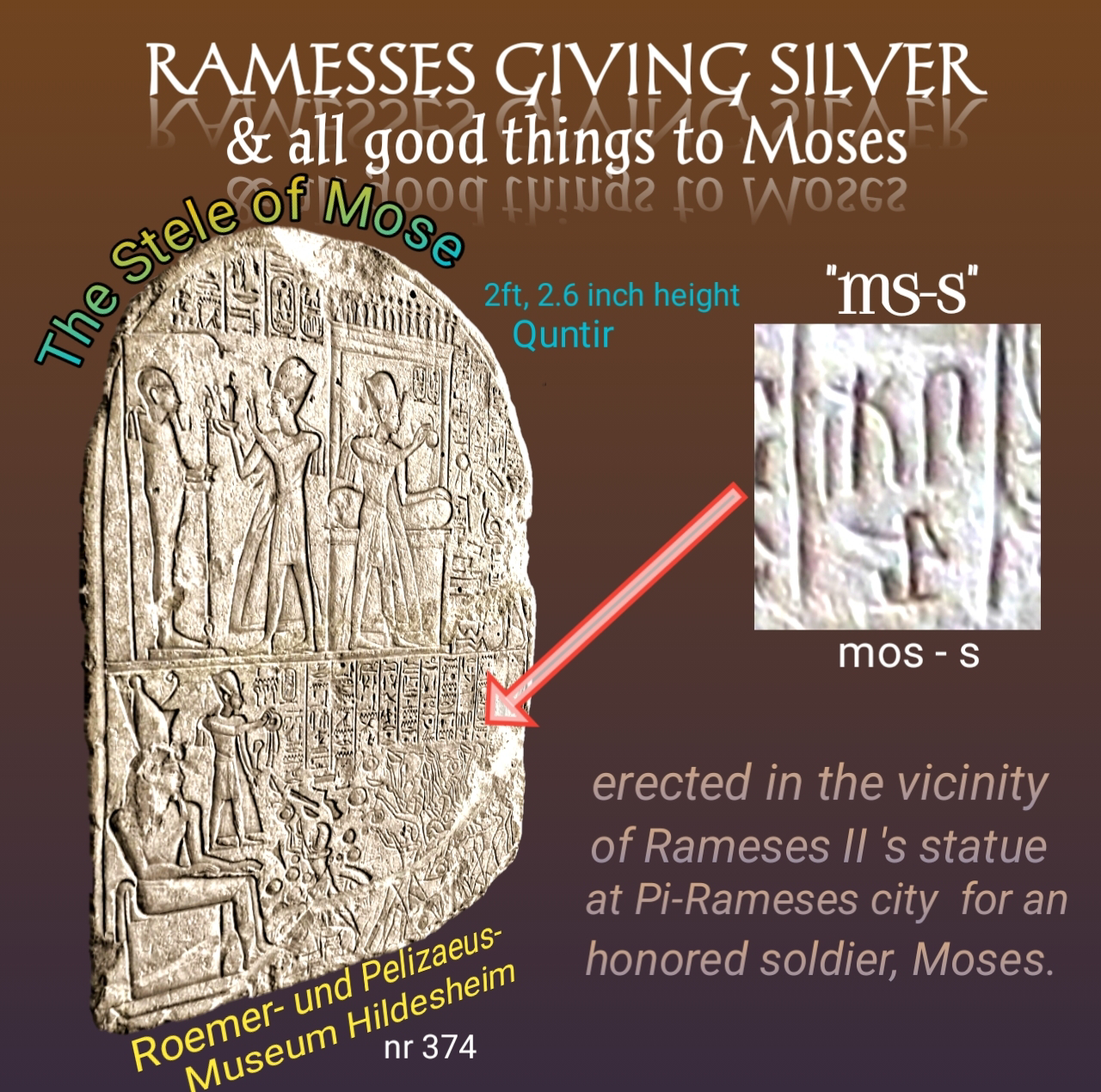
2) ESTELA HILDESHEIM I 374

The direct evidence of this meeting of senior Moses and king Rameses II is officially recorded in the document "Stele of Mose" (aka Stela Hildesheim I 374), now housed at Roemer-und Pelizaeus-Museum Hildesheim (nr 374) in Germany.
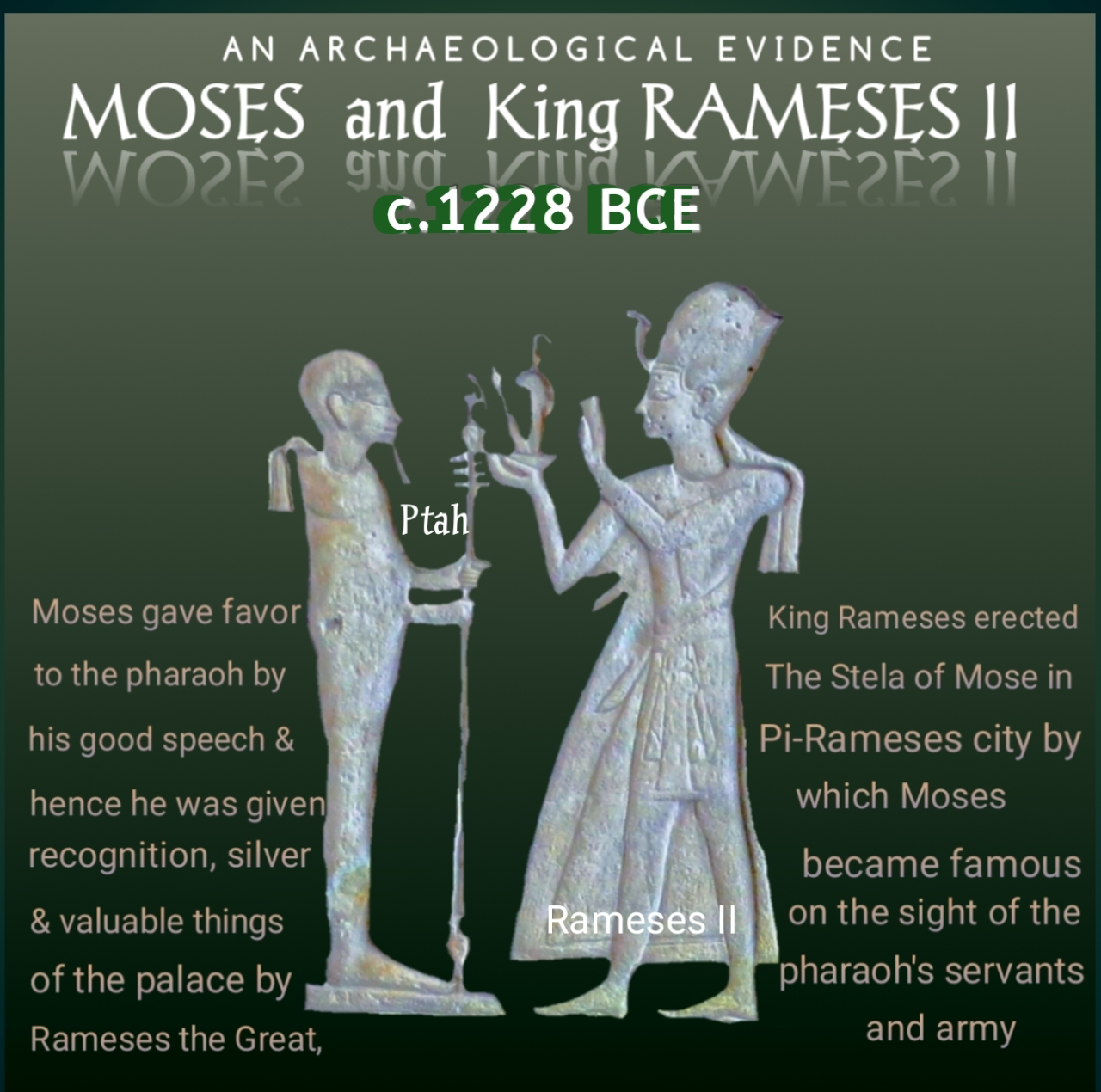
In this document, king Rameses II (1279-1213 BCE) is depicted emerging out of the temple to the front of his own colossal statue outside  the palace, facing publicly the whole army at Pi-Rameses. Why all of a sudden he called the then ordinary "soldier" for an extraordinary occasion?
Rameses was wanting to ask favor both from the whole army and Moses, his childhood classmate in military training perhaps. He was indirectly asking loyalty from them.


"Look," Rameses said, "the soldier Moses has done what (I as) His Majesty asks favor for. How excellent is he has done for (me). So great!"

The soldiers in their military garb with pointed aprons threw up their arms in celebration, and enthusiastically cheered the king, shouting "You are Ra..., we live under your sight." 
Rameses, by using the phrase "mery-Atum" ("beloved of Atum"), identified the origin of Moses as "Atum," the deified "Adamu" ("Adam"), and he gave Moses silver and some treasure of the palace. The soldiers received gifts too from the king, and they celebrated Moses.
Moses became famous on front of the servants of the pharaoh after receiving a great honor from no less than king Rameses the Great, who that time was seeking a guaranteed peace and order - that Moses would not lead the army against the king's favor.

Moses partly corroborated this report when he testified the same incident and suggests that it happened in the year that the firstborn son of Rameses died (1229 BCE).


Exodus 11:2-6

"Speak now in the ears of the people, and let every man borrow of his neighbour, and every woman of her neighbour, jewels of 

silver

and of gold. And YHWH gave the people favor in the sight of the Egyptians. Moreover the man 

Moses was very great

in the land of Egypt, in the sight of Pharaoh's servants, and in the sight of the people. 
And Moses said, Thus says YHWH, About midnight will I go out into the midst of Egypt: And all the firstborn in the land of Egypt shall die, from the pharaoh's firstborn sitting upon his throne, even unto the firstborn of the maidservant that is behind the mill; and all the firstborn of animals. And there shall be a great cry throughout all the land of Egypt, such as there was none like it, nor shall be like it any more." -Exodus 11:2-6
 
The crown prince, Rameses B junior, the then de facto pharaoh (Exo. 10:28-29) had no idea that his last encounter with Moses was ultimately the last, because he died in 1228 BCE while sitting upon the throne of his father.
This untoward incident probably brought the king Rameses to erase the records of Moses. He ordered the tampering of the monumental record of Mohy (Mehy), the soldier behind the successes of his father (Seti I), and likewise the "Stele of Mose" was partly erased. If Moses was not considered having done bad thing against the pharaoh, then there would be no valid reason for his servants to try to erase Moses' stele.

In the Stele of Mose, Rameses is depicted giving gifts to Moses, and allows him to have dominion on certain group of people, symbolized by the rod which Moses is holding on. This seems that Moses' status is almost identical to pharaoh's power to lead an army.


3) SATIRICAL LETTER: PAPYRUS ANASTASI I


Egyptian army scribe, Hori (fl. 1230- c.1160 BCE), likely named him as Maher, and even used Moses' name as a substitute for the pharaoh's name.

And this is another contemporary record which apparently brings out Moses' name. Hori (fl. 1230- c.1160 BCE) was describing Moses as a good judge and likely the best Maher (soldier who guides the army to a dangerous military campaign). A Maher, according to Hori, is "skilled in the deeds of the brave" and "is found (able) to march at the head of an army," shouting "O Mariannu, forward to shoot!" This indeed is what being described in the inscription of the battle of Kadesh above the head of one such Mariannu scout. Maher is a Messenger, who could be also referred to in Exodus as a malakh (angel), with cryptic name "Yah-Mose" ("Moses of Yah") or "Kush-meshusha" ("From Kush," "Born of Yah").


"Behold, I send a 

מַלְאָךְ֙     [Malakh]
Angel 

before you, to keep you in the way, and to bring you into the place which I have prepared. Beware of him, and obey his voice, provoke him not; for he will not pardon your transgressions: for My name is in him. For mine 

Malakh [Messenger/Angel]

shall go before you, and bring you in unto the Amorites, and the Hittites, and the Perizzites, and the Canaanites, the Hivites [Kweans], and the Jebusites: and I will cut them off." -Exodus 23:20-21,23

King Ramesses III (1186-1155 BCE) reported that it was "Yar-su" ("Yar-mesu") who subdued land abroad formerly belonged to Egypt, including to these territories are Kwe, Canaan, Hittite territory, Amorite (Lebanon), and so on.

The malakh (Messenger) being described in Exodus 23:20-23 is identical to what is the opposite of a bad Maher being discussed by Hori in the Satirical Letter (Papyrus Anastasi I).


"Long is the march before us!" But I say: "What it means, that there is no bread at all? Our night-quarters are far off! What means, good sir, this scourging of us? Nay, but thou art a clever scribe! Approach to give the food! 
An hour becomes a day without the scribe from the Ruler. (What means) thy being brought to punish us? This is not good; let 

Mose 

hear (of it), and 
he will send to destroy thee!" -Hori (fl. 1207- c.1160 BCE), Papyrus Anastasi I, 18.2

Hori here is likely alluding Moses as a leader of the army who could provide military rationing despite of the impossibility and who could distribute adequately their necessities even in a long journey, and a man very acquainted with the journey from Egypt to Lebanon, and therefore a judge who could render righteous judgement because of his expertise, even that would mean destruction of the offender. Mose was the opposite of Amenemope being criticized by Hori.
Hori uses the name of "Mose" (Moses) here in lieu of the pharaoh. To distinguish the king from this "Mose," Hori called the pharaoh by the nickname "Sesy," meaning "Vanquisher," referring to king Rameses II. The nickname "Sessy" ("Sese") was later Grecized into "Sesos," which Herodotus transcribed into "Sesostris." 

It is this Hori also who verified the report of Moses and Joshua that there are giant Sheshai of Arba, one of the tribes and known descendants of the Anakim, i.e. people of Anak, inhabiting in Hebron. 
According to Hori (Papyrus Anastasi I, 20-23), these giant Shasu were on a narrow mountain pass above a ravine if you are from Joffa going to Hebron (Arba) or north of Debir. These giant Shasu were 7 to 9 feet tall, waiting for an ambush on the rough road tangled with vegetation.

"Whither shall we go up? our brethren have discouraged our heart, saying, The people is greater and

taller than we;

 the cities are great and walled up to sky; and moreover we have seen the sons of the Anakim [people of Anak] there." -Deuteronomy 1:28

"And the name of Hebron before was City of Arba; which Arba was a great man among the Anakim [people of Anak]..." -Joshua 14:15


"And they ascended by Negeb, and came unto Hebron; where Ahiman [brother portion of]

Sheshai,

and Talmai, the descendants of Anak, were. (Now Hebron was built 7 years before Zoan in Egypt.) And there we saw the giants, ... who come of the giants: and we were in our own sight as grasshoppers, and so we were in their sight." -Numbers 13:22,33

Hori being chronologically Joshua's contemporary corroborated that there were giant Sheshai in Arba (Hebron). And the giant Sheshai is specifically identified as "Ahiman Sheshai" or a portion of the brother of Sheshai.
 The suffix "-i" in Sheshai is what the plural suffix "-s" in English or "-u" in Egyptian hieroglyphics. Hori has "Shasu" for Sheshai. King Rameses II confirmed that there was a place called "sh-sw  w-r-b-r" ("Shasu of Arbar").
Not only in historical inscription, Rameses even depicted the size of giant Shasu he had captured during the Battle of Kadesh.
These three witnesses strengthen the historical fact of their reports about giant Shasu.
Hori described that these giants were dangerous and fierce. Likewise, the 10 scouts (sans Joshua and Caleb), reported the frightening size and activity of these giants, and in fact, the discouragement they brought in Israel caused the reason why Moses ordered them to stay 40 years in the wilderness.
Nevertheless, both Israelites and Egyptians were afraid of these giants, but Rameses and Moses were not.
Consequently, Moses is accurate in his report about these giants during the time of Rameses. 
This accuracy is ready to be rejected by anti-Bible thinkers if it would mean 'during the time of Rameses.' For them, "Rameses" in the Bible is not accurate if connected to Moses.
But such rejection is useless because no less than three persons (Hori, Joshua's companions, and king Rameses II) corroborated each other that there were giants during their time. We have a tight historical fact now that brings Moses, Joshua and Israel in to the timeline of king Rameses the Great. Adding to the weight of this truth is the fact that the people of Yahweh who built Joshua's altar in Mt. Ebal had buried scarabs released by king Rameses II in 1245-1220 BCE.


4) PAPYRUS HARRIS I


The direct evidence for Moses is the official declaration of Ramesses III (1186-1155 BCE) that

Yar-su

"Great" or chief of Kharu (Horite state) of the Seirites, is acting as the ruler of the entire land of Egypt reaching even to abroad, started during the time of king Rameses II and ended when a female became pharaoh and conspired with Yar-su (derogatoric form for the name "Yar-mesu" - "Drew out of river water," Hebrized [Exodus 2:10] as "Moseh," that is "Moses"), and that this Yar-su plundered [Exo. 12:35-37] the entire land where he has gathered his companions, and taught them that the Egyptian gods are only just like humans [Exo.7:1] so that people do not need to bring offerings to their temples. For the first time in history, many men around Mediterranean who joined to Yar-su's confederation were freed from their temple obligation. This practice was spread out not only abroad but even in many parts of Egypt that priest Bakenkhonsu complained about the obliterations did to Egyptian idols and images and that king Setnakhte and Ramesses III said temples were neglected because of the troops of Yar-su (Moses).


"The land belonging to Egypt abroad was abandoned and disloyalty was in every man for they had 

no chief mouth

for many years at the start [ Rameses II ] until the times of others

[Merneptah and Seti II]

when the land belonging to Egypt was formerly under our mayors and city-rulers; one killed another

 [Amenmeses],

and his replacement [Siptah] was a dignitary of wretches. Another

 [Queen Tausert]

 of the family after him was in 
empty years, when
 
Su,

a Kharu,
 
with them acted as outsider 

wer  ["Great" chief], 

making the entire land serving on him only. He united his companions in plundering their properties, and he treated gods as just like humans, that no man was presenting offerings inside the temples." 
- Rameses III, Papyrus Harris I, column 75, lines 2 - 6 
 

Moses became known as the "ur" (literally, "Great", e.g. "chief") of the entire land - Egypt to Mediterranean territories - by usurpation, hence the pharaoh derogatorically shortened his name into "Yar-su" or "Su" to mean no Egyptian god who chose him but "he made himself " or he plundered his rulership. Joshua in publishing the law of Moses corroborated some of it, singing:


"And he said, YHWH came from Sinai, and rose up from Seir unto them; He shined forth from mount Paran, and he came with 10,000s of Kodesh [saints]: from His right hand went a fiery law for them. 
Moses commanded us a law, even the inheritance of the congregation of Jacob. And 

he was 

king

in Jeshurun, when the heads of the people and the tribes of Israel were gathered together." -Deuteronomy 33:2,4-5

There WAS a time that Moses became "king" of the Asherites-Peleset or Jeshurun, and it was when he convened the confederation of the heads of the Mediterranean people and the tribes of Israel, that is, during his latter years. He became known as the ruler of the myriads Seirites (Kharu), although after his death king Rameses III has claimed of destroying Seirites.  King Ramesses III (with his son, Ramesses IV) used the term 

"ur" ("Great"),

likely a translation of Luwian adjective

 "ura" ("great"),

which was used as part of a personal name during the Early Iron Age. 
In a way, "ura-" could be the way "Mesu" (Moses) had been described by Luwian speaking people from Lydia and Kwe (Cilicia), intendedly exchanging the prefix

"yar" (" ir-")

in his Egyptian name "Yar-su" ("Yar-mesu").

Moses in Hittite is "Meshusha," which could be "Mu-ku-sa" in another way of calling him. Xanthus, an ancient Lydian historian, reported that Muksus (Moxos/Moses) was a leader of Lydians who had his operations in Phoenicia (Asher). 

 Ramesses III, and eventually Rameses IV, is suggesting that the disturbances made by Yar-su (Yah-Moses) had started since the latter part of king Rameses II (c.1230 BCE) and ceased when Queen Tausert died in 1189 BCE. If Rameses III was in fact employing "ura-" of the Lydians, then he was in effect identifying Moses as an usurper of kingship or rulership expressing dominion over the land abroad formerly belonged to Egypt. In Moses' last year/s, he convened the tribes of Israel and the heads of the Mediterranean people known in the Bible as "Jeshurun." 
The name "Yar-mesu" may have been altered into "ura-Meshusha" ("Great [king] Moses"). What is certain is that king Rameses III identified

Yar-su (Ir-su)

with the title

"ur" ("Great"), to mean chief of the entire land belonging to Egypt or chief of the Mediterranean territories. Hence, the Mediterranean Ocean was once called "yam Kharu" ("sea of Horite Seirites").

King Ramesses III was around 27 years old when Yar-su (Moses) died in 1189 BCE, the death that is implied by the servants of king Setnakhte. Egyptian historian Manetho positively identified Ramesses III as one of the pharaohs during the time of Moses. The kings of Egypt in Moses' days, according to Manetho's attestation derived from Egyptian sacred writings and recorded in Αἰγυπτιακά (Aegyptiaca, History of Egypt), were

Rhampses (Rameses II), 
Amenephthis (Merneptah), 
Sethos (Seti II), and 
Rameses (Ramesses III). 

Without the permission of the deceased Manetho, using Aegyptiaca, Josephus coerced Thummosis or Tethmosis (Thutmose) to be the pharaoh of exodus and inserted in the scene of the 1579 BCE Hyksos' repulsion, 393 years before the flight of Danaus (Dan) to Argos in 1186 BCE (Against Apion 2.2). Josephus misunderstood Manetho's report about the involvement of Tethtmosis (Thutmose III) when the sons of Israel went out of Egypt to Canaan (Gen. 45:17,21,25) after the pharaoh asked them to go out 25 years & 4 months before Thutmose III died on March 11, 1425 BCE.

When this people or shepherds were gone out of Egypt, to Jerusalem, Tethtmosis, the King of Egypt, who drove them out, reigned afterward twenty five years, and four months, and then died." - Against Apion, i.15 (Josephus)

Manetho, the Bible and Egyptian archaeological findings are in one accord, but most of the rest of modern religious writers thought that Josephus is more accurate than Moses, Manetho, and Egyptian archaeological findings.

///He [Amenephthis] also sent his son Sethos, who was also named Ramesses, from his father Rampses, being but 5 years old, to a friend of his. He then passed on with the rest of the Egyptians: being 300,000 of the most warlike of them against the enemy; who met them. Yet did he not join battle with them: but thinking that would be to fight against the gods, he returned back, and came to Memphis. Where he took Apis, and the other sacred animals, which he had sent for to him, and presently marched into Kush: together with his whole army, and multitude of Egyptians. For the King of Kush was under an obligation to him. On which account he received him, and took care of all the multitude that was with him: while the country supplied all that was necessary for the food of the men; he also allotted cities and villages for this exile, that was to be from its beginning during those fatally determined 13 years. Moreover, he pitched a camp for his Kushite army, as a guard to king Amenephthis, upon the borders of Egypt. And this was the state of things in Kush. But for the people of Jerusalem, when they came down together with the polluted Egyptians, they treated the men in such a barbarous manner, that those who saw how they subdued the forementioned country, and the horrid wickednesses they were guilty of, thought it a most dreadful thing. For they did not only set the cities and villages on fire; but were not satisfied till they had been guilty of sacrilege; and 

destroyed the images of the gods,

and used them in roasting those sacred animals, that used to be worshipped; and forced the priests and prophets to be the executioners and murderers of those animals; and then ejected them naked out of the country. It was also reported, that the priest who ordained their polity, and their laws, was by birth of Heliopolis (On), and his name Osarseph, from Osyris who was the god of Heliopolis: but that when he was gone over to these people, his name was changed, and he was called Moses.” /// -Against Apion i.26
 

The Kush (translated as "Ethiopia") mentioned here near Jerusalem was what king Merneptah (Amenephthis) published and reported in Victory Stele

"Kharu" (Horite state in Seir in Edom)

near the vagabond tribe Israel in 1208 BCE at the border of Egypt. Since Edomites were used as messengers of Merneptah, it was expected that they were obliged to take care the pharaoh during his presence in Edom and his absence in Memphis. The king of Edom was hostile to Moses (Yar-su) and Israel (Num. 20:16-18).
Manetho positively identified whose troops were involved in the execution of the images of gods or idols, and they were those under Moses. The evidence of this claim is found in Athika (Timna Valley) in Edom when Kenite Midianites obliterated very carefully the hieroglyphics and the pharaohs' image and idols in circa 1190 BCE. The next evidence is the mutilation of the pharaohs' images and of the idols in Hazor around 1200 or 1180's BCE.
Manetho claims that Moses was born at Heliopolis. This could be the high probability because Joseph the Dreamer lived at Heliopolis with his wife Asenath (Gen. 41:45,50). Heliopolis was near Goshen.


1) ADMONITIONS OF IPUWER


2) ESTELA HELDESHEIM I 374

3) SATIRICAL LETTER: PAPYRUS ANASTASI I

4) PAPYRUS HARRIS I


1) "The Admonitions of an Egyptian Sage' is written by a 19th Egyptian Dynasty (1292-1189 BCE) scribe, Ipuwer, using an ancient Egyptian hieratic not earlier than 1250 BCE, and it has no other copy and now held in the Dutch National Museum of Antiquities in Leiden, Netherlands. 
The Admonitions of Ipuwer or Ipuwer Papyrus is officially called "Papyrus Leiden I 344 recto." 
The poet writer Ipuwer gives some glimpses about the reasons why and the details what happened in Egypt during the Late Bronze Age Collapse, most importantly how a one man, described as one who poured water, ruined the last years of the advance aged strong man (pharaoh) of the land that even sailing to Byblos and Caphtor became impossible without difficulty, a situation that happened to Egyptians during the time of Yar-su (Moses) or Kush-Meshusha in Cyprus. The strong man being mentioned could be what the then laymen called "Sessy," the Vanquisher, named "Sesostris" by Herodotus. According to Herodotus, Sesostris has monumental reliefs at the Nahr al-Kalb (Lebanon), just north of modern Beirut, which he personally saw and we can also visit them to see. Two of the three reliefs, though badly damaged, have survived and they are inscriptions commemorating the campaigns and victories of king Rameses II (1279-1213 BCE). 

"Thus doing he traversed the continent, until at last he passed over to Europe from Asia and subdued the Scythians and also the Thracians [e.g. Tursha or Truwisha]. These, I am of opinion, were the furthest people to which the Egyptian army came, for in their country the pillars are found to have been set up, but in the land beyond this they are no longer found. [....]
 The pillars which Sesostris of Egypt set up in the various countries are for the most part no longer to be seen extant; but in Syria Palestine I myself saw them existing with the inscription upon them which I have mentioned and the emblem..." - Herodotus, The Histories 2.103,106

This gives glimpse who was the pharaoh very popularly known as the strong man or vanquisher during his lifetime and after his death.


2) Estela Hildesheim I 374 or Stele of Mose, according to Kenneth A. Kitchen (Ramesside Inscriptions, Translated and Annotated Translations: Ramesses II, His Contemporaries [Ramesside Inscriptions Translations] [Volume III] Wiley-Blackwell. pp 187-188, 2001 ISBN 978-0631184287), comes originally in Qantir (Pi-Rameses). In the stela we can read that because king Rameses the Great was "pleased with the speech of his mouth," he personally "gives silver and all good things of the king's house" to Moses. The pharaoh did these for a favor, he wanted the loyalty of the army and senior soldier Moses, and asking them to do what the king loves them to do (Christine Raedler: Rank and Favour at the Early Ramesside Court, in: R. Gundlach, J. H. Taylor [editors], Egyptian Royal Residences, 4th Symposium on Egyptian Royal Ideology, KSG 4,1, Wiesbaden, 2009 ISBN 978-3447058889, p.144). The limestone stela is 2feet 2.6 inches in height and inscribed in around 1230 BCE formerly erected at Pi-Rameses and now held at Roemer- und Pelizaeus-Museum Hildesheim (nr 374) in Germany.

3) The Satirical Letter: Papyrus Anastasi I (officially designated papyrus BM 10247) sheet 6. A personal letter of Egyptian army scribe (royal official) Hori to fellow scribe Amen-em-Opet, who was compared to "m-h-r" (Maher) or "Mose." The papyrus was originally purchased by British Museum from Giovanni Anastasi in 1839.

4) Papyrus Harris I or The Great Harris Papyrus (Papyrus British Museum EA 9999). This 41-meter long papyrus was found in a tomb near Medinet Habu, across the Nile river from Luxor, Egypt, and purchased by collector Anthony Charles Harris in 1855; it entered the collection of the British Museum in 1872. Inscribed with hieratic text, king Ramesses III reported that his father king Setnakhte brought back order in Egypt after expelling the Asiatic followers of Yar-su (Yar-mesu), the Great Chief of Kharu (Horite state of Seir) who subdued the Egyptian territories abroad. 

06 April, 2023

WANDERING MEN AND WOMEN OF ISRAEL


During the time of king Merneptah (Nephtoah), Israel was not living permanently in the places they inhabited, neither they were having their own city nor they were a state or a country that has a king, as inscribed by the writer of the pharaoh in the inscription now known Merneptah Stele (JE 31408). They are hieroglyphically described on the stele as a vagabond tribe near Horite country (Kharu) in Negev in the border of Egypt, or it is also possible that they were described as part of Egyptian but revolting against the pharaoh's government.


Like Libyans who wandered from Tehenu to Egypt, Israel is described as composed of vagabond men and women. The only difference, Merneptah described that Tehenu Libyans are travelling with their king and throne, whereas Israel has no king and no royal throne. Libyans are also described to have their own state, whereas Israel is described as being part of Egypt or having no own territory. Israel in Seir (Deut. 33:2) was not yet established. Israelites are vagabonds whose disturbances and influence to other countries (e.g. Kharu and Yenoam) are enough to call the attention of Merneptah, the first leader of Egypt who used the word "pharaoh" as the title king. For the first time since the latter part of king Rameses II, when chaos was brought by Israel and by the Late Bronze Age Collapse out, Merneptah broke the silence against the people who was under the influence of Yar-su (Yah-mesu) and made an official announcement that he devastated Israel and annihilated its seeds. He wrote it in a big document now known the Victory Stele (JE 31408)


Some of the contents of Merneptah Stele are events really corroborated by the Bible and other Egyptian inscriptions. And by this document we can learn how ancient scribe wrote their history during their era, e.g., they wrote it in a poetic way or by a song.


"Year 5, 3rd month of summer, day 3, ...Merneptah,... slays his foes,...
Shu [Air] dispelled what was covering over Egypt, letting Egypt see the rays of the sun, and imprisoned folk can breathe now when the bar from their neck

the mountain of copper,

was removed,

when Hut-ka-Ptah [Ai-gu-ptos] exults over its foes,...who steadied the hearts of 100,000s,...
Woe to Libyans,...In a single year were the Tjehenu burned!...There's no work of carrying [loads] these days. Hiding is useful, it's safe in the cave.... [for those] who attacks the border!
...So say they who gaze toward their stars, And know all their spells by looking to the winds.
...Merey the vile foe, the Libyan foe had come to attack the walls of Ta-tenen, whose lord had made his son arise ...He will deliver him to his ka in Southern Heliopolis, ...Merneptah,...
...Fortresses are left to themselves,
wells are open for the messengers' use.

...The [elderly] princes are prostrate saying: "Shalom!"

Not one of the 9 Enemies lifts his head:
Libyan Tehenu [people, enemy state] is vanquished,
 Hittite Khatti [enemy state] at peace,
[Central] Canaan is plundered with all woe.
Ashkelon state is conquered, 
Gezer state seized,
Yanoam state is seen to totally not exist;
[tribe] Israel, of many wandering hunted men & women, is devastated, his seeds no longer exist,
Kharu enemy-state [Horite in Seir] is become a widow because of Egypt.
All who roamed [restless] have been subdued.
By the King of... Egypt,..."
- Merneptah Stele (1208 BCE) 


King Merneptah is reporting that "wells are open for the messengers' use," and this claim is confirmed both by Amenomopet in 1211 BCE (ANET 1969, 258) and Joshua.


"And the south quarter was from the end of Kirjathjearim [City of Forests], and the border went out on the west, and went out to the 

Mayan Mei-Nephtoah
[Well of waters of Nephtoah]." -Joshua 18:15


This same Well of Mei-nephtoah is also recorded in Papyrus Anastasi III when Amenomopet from the Wells of Mer-neptah in forests attended a judicial investigation heard at Sile in around 1211 BCE.

The meaning of "mayan mei nephtoah" literally is "spring of water of water's spring." 
The last words "mei nephtoah" appear to be a name of "mayan," hence it could be "Well of Mei-Nephtoah" or "Well of Mer-Neptah." 

King Merneptah was popular by these wells, that scribes during his time named them after him.

 Why he needed to make wells or water supply? Because drought was spreading from Atlas (Tursha) to Anatolia (Lydia and Hittite territories), causing famine. Late Bronze Age Collapse was very disastrous as described by scribe Ipuwer (fl. 1250- c.1160 BCE) in the Admonitions of the Sage written during the latter time of king Rameses II to the time of Rameses III (1186-1155 BCE).


Merneptah is accurate in his timeline because Joshua (1248-1138 BCE) was contemporary of Caleb, who was the uncle of Othniel, the judge who defeated Chushanrishathsim of Aram Naharim in 1185 BCE, causing the destruction of Emar. This Chushanrishathsim had likely founded a town after his own name which was contemporary to king Rameses II (1279-1213) and Ramesses III (1186-1155 BCE). Thus, Joshua in effect is accurate too in mentioning the Spring or Well of Mei-Nephtoah during his own time. 


Anti-Bible thinkers rejected this accuracy and claim that it is an anachronism because "future" or later scribes wrote it. When asked who were those later scribes. They are the nameless scribes in their imagination, not found in the Bible (basing their belief from the imagination of their mind), and worst they claim that their imagination is more accurate than the Bible and Egyptian inscriptions.


But the fact is, both Joshua, king Merneptah and Amenomopet are accurate because they were chronologically contemporary of each other (that is, both Joshua and Amenomopet of their days have mentioned "Well of Mei-Nephtoah" and "Wells of Mer-neptah," respectively).


Historical fact and scientific studies confirmed that there was a great famine during the time of king Rameses II and Merneptah, and this famine occured in Hittite territories and nearby countries. Not only this, Israel marked 1210 BCE as the year zero of their historical Jobilee because of that worst famine. Historically speaking, the worst famine was during the reign of Merneptah, who reported about Hittite king Tudhaliya IV, whom he "caused to take grain in ships to keep alive that land of Hatti" (KRI IV 5,3).


 Tudhaliya IV (1237-1209 BCE) built 10 dams for water supply, and this may be connected to what Ugarit king Ammurapi (r. c.1214- c.1190 BCE) wrote, that there was a "severe famine" (RS 18.147, KTU 2.46). 
Merneptah considered this phenomenon as a favor to him by Air, the god Shu of Egyptians, which cleared the covering upon Egypt up that caused darkness in the past, and 

removed the mountain called "Copper" (the area of the Kenite copper smithers), 

resulting to the freeing of the Egyptian folks.


Were the Israelites in Canaan firmly established during Merneptah's time? 

Unfortunately, no. We can know this fact because until 1208 BCE Israel did not have their own city or territory in Canaan, and they were hieroglyphically described by Merneptah as vagabond tribe composed of fighting men and women, particularly that Moses was not around and no leader on the ground to take responsibility, leading to the leadership of prophetess Deborah and the request for Gideon (Jerubbaal) to be a leader. Just in the previous year (1210-1209 BCE), Akwesha (Asherites) and Shakarus (Issacharites) stopped circumcising Hebrew babies after Merneptah became determined to annihilate Israel. The news of this situation reached Moses, who pampered them that though their sons were not circumcised in the flesh, " YHWH thy God will circumcise thine heart, and the heart of thy seed, to love YHWH thy God with all thine heart, and with all thy soul, that thou mayest live" (Deuteronomy 30:6). 
The rite was resumed by Joshua on March 28, 1189 BCE likely after their long sojourning in Har Karkom (5 days distant from the center of Makhtesh Ramon), but this resulted to king Rameses III to revive to hunt the circumcised fighters of the confederation headed by Yar-su (Yah-mesu).


"And this is the cause why Joshua did circumcise: All the people that came out of Egypt, that were males, even 

all the men of war,...

...were circumcised: 

but all the people that were born in the wilderness by the way as they came forth out of Egypt, them they had not circumcised. - Joshua 5:4- 5


Needless to say, there was a period in Israel's history that Israelite babies' circumcision ceased, and when this abolition became complete, Merneptah boastfully announced that the seeds or children of Israel were annihilated (Victory Stele, line 27). The people is devastated, and the children were taught to be annihilated for having no circumcised boys. He depicted Israel not as a state (nation) but as a people wandering near Horite state (Kharu).

Merneptah did not write determinative "three hills" - read as "khasu" ("khasut"), beside or under the hieroglyphic sign for the sitting men & women. This may mean that Israelites were indeed vagabond, wandering from one place to another to fight. 

Khasut, the hill-country, is understood as a "country of foreigners" - that is, foreigners' territory, which lacks in the description for Israel. Khasut suggests of being a state or a nation, district, or land with military capabilities.
This may imply that Israel was probably under the claw of Egypt if we will consider the absence of "foreign land" determinative as an acknowledgement of being part of Egyptian, because that is also how Egyptians depicted themselves in the hieroglyphic spelling. 

However, unlike Egyptian fighters in the hieroglyphics, the "throw stick" determinative, which was first used to mean to hunt or as weapon in the animal hunt (being portrayed in the Hunters Palette), hence it signifies hunted foreigner or foreigner territory ("enemy"), is used in line 27 before the signs of men & women. 

The pronoun used for Israel is masculine ("his," referring to the patriarch - owner of the name, hence to his tribe) rather than feminine ("her," which is usually being used to mean a country/nation). 

The hieroglyphic sign "horned viper" is what letter "f" in English alphabet but it signifies masculine in Egyptian writing if used to refer to a person or patriarch and translated "he," "his," or "him." It is used as masculine pronoun for Israel in the stele. The hieroglyphic signs used here mean that "Israel" was a people and not a land.


And this wandering of Israel in 1209 BCE or earlier was part of their 40-year exodus from the time that the Crown Prince of Rameses sitting on the throne of the pharaoh died in 1229 BCE (Num. 33:3-5) until Yar-su (Yah-mesu) and Queen Tausert died in 1189 BCE. 


Merneptah concluded that he facified these people who roamed in Kharu (Seir) to Canaan. 

ARAB ARABIA ARABAH

SAUDI ARABIA: the phrase " Saudi Arabia " was officially invented on 23 September AD 1932 by its founder, Abdulaziz b...