08 June, 2022

WHEN DID THE EXODUS HAPPEN?


The person who can answer this is no other than but the direct eyewitness, Moses himself.

Moses wrote the original information of the book we called today "Genesis" during the time when Avaris was popularly known by the topographical name Rameses. According to Moses:

"Joseph placed his father and his brothers, and gave them a possession in the land of Egypt, in the best of the land, in the 

land of Rameses,

 as Pharaoh had commanded." -Genesis 47:11

Avaris (hw.t wꜥr) was known during the time of Moses as "Rameses," and this latter topographical name was reverberating to his memory because their exodus, that he had directly witnessed, took place when they left Rameses.

The geographic names that Moses has mentioned when they had had their exodus were 13th century BCE topographical names, namely:

1) Succoth,
2) Rameses,
3) Pithom (Per-Etham),
4) Baalzephon,
5) Pihahiroth, and 
6) yam suph.

1) There were 3 toponyms known in ancient Egypt by the name "Tjeku" (Succoth).

A. zone,
B. city, and
C. enclosure.

 Tjeku (Succoth) was known as early as 1393 BCE naming Amenemhet as the "hry pdt" (troop commander) of Tjeku. The same office was existing in Tjeku (Succoth) in the 13th century BCE described in Papyrus Anastasi 5. Tjeku is usually written with a throw-stick (hieroglyph for "enemy") and foreign-land determinative.
But in a fragment of a draft of letter Deir el-Medina ostracon (ODM) 1076, line 1, Tjeku (Succoth) is written with a city determinative and is located near the region of Rameses.
In 1206 BCE the "brkt pr-itm (pools of Pithom) Mer-neptah" is identified as "Tjeku" ("Succoth"). It was a military zone; described in Papyrus Anastasi 6 as
 
"p3 htm n mr-n-pth khr m33t nty thkw"
("the etham [fortress] of Merneptah khetep-hir-maat which is Tjeku"). 

The etham (tower) of Merneptah is either Succoth or in Succoth.

Inside Succoth, there could be a settlement named also as "Tjeku," and in Papyrus Anastasi V  it is described "p3 sg3r n tkw" ("the enclosure [wall] of Succoth").

2) Rameses was not in Saudi Arabia, nor it was near Aqaba Sea. A city in that region (Rameses) was known to Moses as "Raamses," called "Pi-Ramesse..." by the Egyptians and which was near in the region where Tjeku (Succoth) was belonged.
This is clearly indicated in Deir el-Medina ostracon 1076, lines 1-5:

"... in the favor of all the gods of Tjeku [Succoth] ... Thus one speaks in the Great House [pr '3], L.p.h. the great [meadow] of Pi-Ramesse Great of Victories... and one sent to the horse-keepers..."

Papyrus Anastasi III, 1:12 describes this city as the domain of king Rameses the Great or

" pr-rˁ-ms-sw-mry-ἰmn " (Pi-Rameses Meriamun)

and as located in the region called "Rameses" (Anastasi III, 3:3-4).

The city of Rameses was not built earlier than king Seti I. That is, there was no city named Rameses in 1446 BCE. Ground-penetrating radar (GPR) and Caesium-Magnetometry surveys done in 1996, 2003, and 2008 can demonstrate that the palace of king Seti I in the city was built on a virgin ground. This scientifically means that Moses was talking to a new city (Raamses) on a virgin ground when it was reported in the phrase "Pithom and Raamses."

3) In Tel el-Retabeh king Rameses II (1269-1213 BCE) built " pr-tm ṯkw " (Per-tum Tjeku) or Pithom in Succoth.

4) Papyrus Anastasi III, 2:8 has "water of Baal- " located near Rameses. A 6th-5th century BCE Phoenician papyrus speaks of Baal-Zephon as the principal god of Tahpanhes. People during the 6th century BCE (Ezekiel 30:18 and Jeremiah 2:16) likely changed the name "Zaphon" into "Tahpan-," which is Arabecized into "Defeneh."
In around 1225 BCE, in Papyrus Sallier IV, 1:6 

"bˁr-ḏȜpn" ("Baal-Zephon") 

is mentioned with Seth hieroglyphic determinative symbol. This gives us insight that exodus of Israel happened near 1225 BCE.


5) In around 1210 BCE Papyrus Anastasi III, 2:9  a toponym "pr-ḥwt-ḥrt" ("Pihahirot") is described to be belonged in the region Rameses near yam tufy (Reeds' Sea). The name may mean "Pi (Precinct of) Hahiroth (Avaris)." Obviously it is a combination of "pr" ("per-" : "precinct") and
 "hwt-hrt" (derived from feminized "hw.t wꜥr" : Avaris).
 Hahiroth has a goddess determinative hieroglyphic symbol, hence it is a theophoric name. It is thought to be derived from hieroglyph "p3 hrw" ("the canal"), which may refer to the canals of Avaris (cf.Hoffmeier 2005: 105-107).

6) Yam Suph (Hebrew for "Sea of Reeds") mentioned in Exodus 10:19 has its name derived from Egyptian "p3 ym" (pe yam) & "twfy" (tufy) located in Rameses near Pihahiroth according to the geographical description in Papyrus Anastasi III, 2:11-3:4. Pe-yam in this Egyptian inscription is what Numbers 33:7-8 mentioned "ha-yam," which according to a scribe in 1210 BCE was located just near Tufy (Egyptian toponym that literally means "Reeds"). Moses combined this toponyms into yam suph (Reeds' Sea). There were a lot of reeds' seas (lakes of reeds) from Egypt to Negev or Edom, but the yam suph (Reeds' Sea) where the Israel passed on dryshod was near Pihahiroth (Precinct of Avaris) in Rameses.


Numbers 33:2-8

"And Moses wrote their journeys... And they departed from 

Rameses

 on the 15th day of the 1st month; on the day after the Passover the descendants of Israel went out with an high hand in the sight of all the Egyptians. For the Egyptians buried all their firstborn, which YHWH had smitten among them: upon their 

gods

 also YHWH executed judgments. 
And the descendants of Israel removed from Rameses, and camped at

 Succoth.
 
And they departed from Succoth, and pitched in 

Etham,

 which is in the edge of the wilderness. 
And they left Etham, and turned again unto Pihahiroth, which is before

 Baalzephon: 

and they pitched before Migdol. 
And they departed from before

 Pihahiroth, 

and passed through the midst of 

ha-yam
[the sea]

 into the wilderness, and went 3 days' journey in the wilderness of Etham..." -Numbers 33:2-8


There was a pharaoh who was celebrated as one of the Egyptian gods, who were considered judged by YHWH by the death of his firstborn son. According to Moses, the said pharaoh's firstborn son was sitting on the throne of the pharaoh when died, corroborating Moses' report that it's the judgment against Egyptian gods, implying that the pharaoh was an Egyptian god. Moses also clearly reported that the king was the pharaoh of Rameses. 


Who was the pharaoh of Rameses whose firstborn son sitting on the throne died when the pharaoh was one of the Egyptian gods and whose predecessor died when Moses was at 20's and who built store-cities Pithom & Raamses?

These details given by Moses are pin pointing to no other but one person: king Rameses II (1279-1213 BCE).
Let us know why it was referring to king Rameses II.

1. The pharaoh who built Pithom and Raamses was king Rameses the Great (1279-1213 BCE). 
 King Rameses II has categorically stated: "I built Pithom."
Scientists found the Pithom built by king Rameses II in Tel el-Retabeh.

2. There was only one pharaoh from whom the geographic name "Rameses" was derived.
 King Rameses II built the store-city or best city "Pi-Rameses" known in the Bible as "Raamses."

3. At Moses' "gadal" (20's), in 1279 BCE, pharaoh died. 

"And it came to pass in those days, when Moses 

wa-yigdal
[was grown], 

that he went out unto his brethren, and looked on their burdens... And it came to pass in process of time, that

 the king of Egypt died

and the descendants of Israel sighed by reason of the bondage..." -Exodus 2:11,23

This pharaoh died and succeeded by another pharaoh (the king who was involved in exodus of Israel). The pharaoh who died was Seti I, and the successor was Rameses II.


4. It was king Rameses the Great who became too serious to be known as one of the Egyptian gods. 
At his Year 30 in circa 1250 BCE, he celebrated his first heb sed (jubilee festival), when Ramesses B junior  was the crown prince. As a consequence, Prince Ramesses junior has to sit on the throne of his father (Rameses II) and act as a pharaoh in behalf of his father: as Rameses II (the real pharaoh) was ritually performing as an Egyptian god. 
The first affected of the death of the crown prince firstborn son was Rameses II the Great himself. Prince Ramesses B died during the Year 50 of king Rameses II in 1229 BCE.


The reason why Israelites were asked by Egyptians to leave Egypt was the death of the firstborn sons, and the incident happened when the pharaoh's firstborn son was sitting on the throne: and this death was a judgement of YHWH against the Egyptian gods, and one of these gods was the pharaoh himself. As a result, the pharaoh permitted the 600 elef (head-of-thousand) to leave Rameses.


According to apostle Paul, a former devoted Benjaminite Pharisee, the affliction took place 430 years after Abraham received a promise from God.


"Now to Abraham and his seed were the promises made... And this I say, that the covenant, that 

was confirmed

... 430 years after, cannot disannul, that it should make the promise of none effect. For if the inheritance be of the law, it is no more of promise: but God gave it to Abraham by promise." -Galatians 3:16-18


Older versions of the Hebrew Bible are confirming the teaching of apostle Paul in the 1st century.


"And the sojourning of the children of Israel, while they sojourned in the land of Canaan and in Egypt, was 430 years." -Exodus 12:40, Septuagint (LXX h), c. 250-150 BCE


‍"And the sojourning of the children of Israel, while they sojourned in the land of Canaan and the land of Egypt was 430 years." -Exodus 12:40, Samaritan Pentateuch (SP), c. 100 BCE

The very term 

וּמוֹשַׁב֙
ū·mō·wō·šaḇ


is used only thrice in Hebrew Scriptures (in Exodus 12:40, 1Kings 10:5, and 2Chronicles 9:4) both referring to seating/sitting of servants. Its root word may also mean settlement, habitation or dwelling.

"The 

ū·mō·wō·šaḇ
[seating/sitting (of the servants)]

of the children of Israel - while they

יָשְׁב֖וּ
yā·šə·ḇū
[dwelt]

 in the land of Canaan and the land of Egypt was 430 years - when it came to pass at the end of the 430 years, even the selfsame day it came to pass, that all the hosts of YHWH went out from the land of Egypt." -Exodus 12:40-41

The passage is understood as those who 

yāšəḇū
(dwelt)

to the 430th year, and those who 

·mōwōšaḇ
(seat/sojourned). 

There were two sets of people here: (1) those who dwelt (yasebu) 430 years ago before the fulfilment of the promise, and (2) those who sojourned (mowosab) in the end of the 430th year during the exodus.


This passage is telling us that "THEY dwelt in the land of Canaan and in the land of Egypt ... 430 years" and that it came to pass at the end of 430 years that all the host of YHWH (the children of Israel) went out from the land of Egypt. 

The "katōkēsan" ("they sojourned") refers to THOSE who dwelt in Canaan and Egypt back to 430th year ago. 
If the Pharaoh's firstborn son sitting on the throne died in 1229 BCE, then the 430th year before that death was 1659 BCE, which was during the time of Abram (1738-1563 BCE).


1229 BCE exodus
+  430 years
__________________
1659 BCE

Abram went to Egypt when there was a famine.
Scientific studies on the pollen grain of Mediterranean indicate that around 1650-1610 BCE there was drought and possibly a famine.


Abram was 75 years old when he left his moledeth (birthplace) Haran in 1664 BCE. 

"Now the LORD had said unto Abram, Get thee out of thy country, and from thy 

מוֹלֶדֶת
[moledeth]
birthplace,

and from thy father's house, unto a land that I will shew thee: 
So Abram departed, as the LORD had spoken unto him; and Lot went with him: and Abram was 75 years old when he departed out of Haran." -Genesis 12:1,4

Harran or Nahor was the region of birthplace (moledet) of Abram (Genesis 24:4,10).


Abram needed to transfer to his birthplace (Haran) when his father, Terah (Terru), encountered a life-or-death threatening from Urkasdim (people of Urkesh).

"Now these are the generations of Terah: Terah begat Abram, Nahor, and Haran; and Haran begat Lot. 
And Haran died before his father Terah in the land of his nativity,

בְּא֥וּר כַּשְׂדִּֽים
[ba-Urkaśdîm]. 

And Terah took Abram his son, and Lot the son of Haran his son's son, and Sarai his daughter in law, his son Abram's wife; and they went forth with them  

מֵא֣וּר כַּשְׂדִּ֗ים
[from Urkasdim], 

to go into the land of Canaan; and they came unto Haran, and dwelt there."-Genesis 11:27-28,31


Like his ancestor Tudiya Adamu ('Adam the Beloved of Yah'), Terah did not use the title "Shar" ("king"), which they considered for the God only. But the description given in some cuneiform tablets from Mari, we can discern that Terru (Terah) was a king.
Terru ruled in Urkesh in the west river of Peleg's territory, and among his subjects were 

Habiru 

(Archives Royales de Mari [ARM] 100:22f).
The birthplace of his son Haran was the country of Urkasdim (people of Urkesh).

 “Because I have cast my lot with my lord, people in my town hate me. A couple of times I have had to save myself, escaping death” - Terah, ARM 28 44bis

Zimri-Lim replied: “I did not know that the sons of your city hate you on my account. But you are mine, even if the city of Urkesh is not.”

 Urkash-dim (sons of Urkesh) got mad against Terah for surrendering to Zimri-Lim or after casting his lot to king Zimrilim as his suzerain, and they threatened his life, resulting to his departure toward Mari, but found his haven in Harran. Consequently, Ariukki became king of Urkesh. 


Governor of Nahor, Itur-Asdu, sent an emissary to Mari to remind king Zimrilim about the impending weakness of the fraternity, when others were strengthening theirs.

"There is no king who is strong by himself alone. Hammurapi of Babylon has 10 or 15 kings, likewise Rim-Sin of Larsa, Ibalpel of Eshnunna, 

Amarpel of Qatna [Shinar];

whereas Yarim-Lim of Yamhad has 20 kings." 


When a solar & lunar eclipse was interpreted by king Zimrilim's palace as a downfall of Babylon, Hammurabi readied to march against Zimrilim, who was actually his ally. Hammurabi gave permission to those people who would want to depart from Mari before he would destroy it into pieces. 
Therefore, Abram became free from this suzerainty bondage, and his God asked him to go to Canaan.

After the disappearance of Zimri-Lim (1665 BCE), Abram left Haran and went to Shekhem (Shamkhuna). 


In Egyptian Execration (Brussels) Texts # 55, Abraham is called

 "Aburahan, ruler of Shamkhuna [Shekhem]" 

who in 1630's BCE was a contemporary of the 

"ly-Anak"

 whose patriarch was Abi-Yamimu ('Father Emim').

Ariukki, king of Urkush (c. 1664 BCE), which was a vassal of Zimri-Lim, became involved in a conflict when king Kedor-la-omar of Eram asked a back up from their leader Amarpel of Qatna (between Two Rivers) after five Palestinian kings rejected to give tribute to Kedor-la-omar when Mari was destroyed by king Hammurabi of Babylon.

The attack of king Kedor-la-omarAriukki (Arioch), Amarpel (Amutpiel), and Tigdal in Sodom in circa 1664 BCE coerced Abram to have confederacy with the Amorite Habiru and enabled him to rescue Lot. 
Joseph, his great-grandson, mentioned that Amorite Hebrews had land in the same region (Genesis 40:15).
 
In 1639 BCE God promised to Abraham that his descendants would possess Canaan's land 430 years after the covenant (Genesis 17:7-8, Galatians 3:15-18). And this had materialized when king Merneptah reported in 1208 BCE the wandering of Israel near Kharu (Horite state) in the border of Egypt. Asherites (Akwesha) & Issacharites (Shakares) started to fight in 1210 BCE to claim a land in Egypt.

  "And when Abram was 99 years old, the LORD appeared to Abram, and said unto him, I am 

El Shaddai; 

walk before Me, and be thou perfect. And I will make My covenant between me and thee, and will multiply thee exceedingly. 
As for me, behold, My covenant is with thee, and thou shalt be a

 father of many nations.
 
Neither shall thy name any more be called Abram, but thy name shall be 

Abraham;

 for a father of many nations have I made thee. And I will establish My covenant between me and thee and thy seed after thee in their generations for an everlasting covenant, to be a God unto thee, and to thy seed after thee. And I 

will give

unto thee, and to thy seed after thee, the land wherein thou art a stranger, all the land of Canaan, for an everlasting possession; and I will be their God." -Genesis 17:1-2,4-5,7-8

This promise had materialized when men & women of wandering tribe Israel started to dwell in Sinai (Horeb) between Seir (Kharu) & Kadeshbarnea and in Yenoam (near Rukkath), and caused disturbances that triggered king Merneptah to respond in 1208 BCE.


1639 BCE promise
- 430 years
___________________
1209 BCE

And yes, 1209/1208 BCE had historical significant to ancient Egyptians, Greeks, Tyrians, and Hebrews, and by that year they counted the Trojan War and other events.
The year zero of historical Israel's Jubilee started just a year before it, when there was a severe famine in many parts of the Mediterranean.


The 430 years may mean surpassing the 400 years promise to the descendants of king Seth (the ancestor of king Rameses II) to possess Avaris from 1646 BCE. King Rameses the Great made it popular after his 2nd heb sed and commemorated the taking of the land (which he called Pi-Rameses) to be theirs as an honour to his patriarch, king  Opehti-Set Nubti. Seth, ruler with red hair, was related to the Aamu (Ham), and later to Shakaresh (Issacharites), Denyen (Danites), and Shasu as far as the tassels of his lower garment is concerned. He was ostracized in Egypt in 1650's BCE. The historical person who could be referring to his persona was Seth Merybre, who was trying to gain control in Memphis. 
Seth was deified in Avaris during the time of Abraham (1738-1563 BCE).
And after 400 years, his descendant (i.e. Rameses II) was announcing the fulfilment of the taking control of Avaris by remembering what king Seti I, Rameses II's father, had done. Rameses the Great erected the Stele of 400 Years in Pi-Rameses.

Moses has a counter for this: that is, 400 years after Abraham had received a promise from Yah El Shaddai (1639 BCE) his seed should be afflicted in the land not theirs.

"And he said unto Abram, Know of a surety that thy seed shall be a stranger in a land that is not theirs, and shall serve them; and they shall afflict them 

400 years;
 
But in the 4th generation they shall come hither again..." -Genesis 15:13,16

In the 4th generation Abraham's seed would come back to Canaan.


Moses' record identifies the 4 generations from their dwelling in Egypt during the time of Jacob (Israel) till their exodus.

1) Levi (1494-1356 BCE),
2) Kohath,
3) Amram, & 
4) Moses (1309-1189 BCE).

Jacob (1578-1432) was the son of Isaac (1637-1459), the son of Abraham.

Sodom and Gomorrah were destroyed by a fire from heaven in 1638 BCE, almost a year before Isaac was born. 

Scientific study in the 1650 BCE stratum of the palace of Tel el-Hammam in Sodom proved that indeed there was a swift destruction of the area caused by a super hot object from sky. This only means that the Bible is right on its scientific historical timeline for Abraham.

During the time of Isaac (1637-1459), in around 1550 BCE king Ahmose prohibited Hyksos or Shepherds from Canaan to enter Egypt, hence Isaac could not go in Egypt.

"And Isaac intreated the LORD for his wife, because she was barren: and the LORD was intreated of him, and Rebekah his wife conceived. 
...Isaac was 60 years old when she bare [Jacob and Esau]." -Genesis 25:21,26

Jacob and Esau (Edom) were born in 1578 BCE.

In 1469 BCE Jacob's sons sold Joseph to Midianites (Ishmaelites of Negev). 

"These are the generations of Jacob. Joseph, being 17 years old, was feeding the flock with his brothers... And they sat down to eat bread: and they lifted up their eyes and looked, and, behold, a company of Ishmeelites came from Gilead with their camels bearing spicery and balm and myrrh, going to carry it down to Egypt. 
'Come, and let us sell him to the Ishmeelites, and let not our hand be upon him; for he is our brother and our flesh.' And his brothers were content. 
Then there passed by Midianites merchantmen; and they drew and lifted up Joseph out of the pit, and sold Joseph to the Ishmeelites for

 20 pieces of silver:

 and they brought Joseph into Egypt. 
And the Midianites sold him into Egypt unto Potiphar, an officer of Pharaoh's, and captain of the guard." -Genesis 37:2,25,27-28,36


Slave value during the time of Jacob (1578-1432 BCE) was "20 shekels" giving us an idea that he was near the era of Hammurabi (1696-1654 BCE). His favorite son, Joseph, was sold as a slave at 20 shekels.


In 1456 BCE Joseph became food steward in the whole land of Egypt, and in Heliopolis (biblical city of On) he became also a priest (the position called father-of-god in Egypt, "father of Pharaoh" as mentioned by Joseph).

"And Pharaoh called Joseph's name Zaphnathpaaneah; and he gave him to wife Asenath the daughter of Potipherah priest of Heliopolis. And Joseph went out over all the land of Egypt. And

 Joseph was 30 years old

 when he stood before Pharaoh king of Egypt. And Joseph went out from the presence of Pharaoh, and went throughout all the land of Egypt. And in the 7 plenteous years the earth brought forth by handfuls. 
And he gathered up all the food of the 7 years, which were in the land of Egypt...And the 7 years of plenteousness, that was in the land of Egypt, were ended." -Genesis 41:45-48,53

The 7 Years of Gathering Grains:

1) 1457/1456.
2) 1456.
3) 1455.
4) 1454.
5) 1453.
6) 1452.
7) 1451.


In the Year 2 of famine in 1449 BCE the children of Israel went to their sibling Joseph in Egypt to buy foods for the second time. And by that time Joseph revealed his true identity to them.


The 7 Years of Famine:

1) 1450 BCE.
2] 1449 BCE.
3) 1448 BCE.
4) 1447 BCE.
5) 1446 BCE.
6) 1445 BCE.
7) 1444 BCE.


"For these 2 years hath the famine been in the land: and yet there are 5 years, in the which there shall neither be earing nor harvest. 
And there will I nourish thee; for yet there are 5 years of famine; lest thou, and thy household, and all that thou hast, come to poverty." -Genesis 45:6,11

That year, 1449 BCE, the children of Israel went out up from Egypt to Canaan to their father, Jacob, to bring him to Joseph.

Genesis 45:17,21,25

"And Pharaoh said unto Joseph, Say unto thy brethren, This do ye; lade your beasts, and go, get you unto the land of Canaan; 

And the children of Israel did so ...
And they went up out of Egypt

and came into the land of Canaan unto Jacob their father" -Genesis 45:17,21,25

According to 1Kings 6:1 this happened 480 years before king Solomon built the temple of YHWH.

"And it came to pass in the 480th year after the 

בְּנֵֽי יִשְׂרָאֵ֣ל
[benê Yisrael]
children of Israel 

were come out of the land of Egypt,

 in the 4th year of Solomon's reign over Israel, in the month Zif, which is the second month, that he began to build the house of YHWH." -1Kings 6:1

1449 BCE (Year 2 of famine)
- 480 years
____________________________
  969 BCE 


Solomon started to build the temple in 969 or 968 BCE, which was his regnal Year 4.

According to Tyrian timeline, king Hiram helped king Solomon to built a temple in Jerusalem during the 241st year founding of Tyre (Josephus' Antiquities 8.3.1 & Against Apion 1.18).
Pompeius Trogus, according to Justin 18:3:5, said that Tyre was founded one year before the taking of Troy.
In Parian Chronicle, Troy was taken on 10th June, 1208 BCE


1209 BCE founding of Tyre
- 241 years
___________________________
   968 BCE


This means that 241 years after the founding of Tyre in 1209 BCE, Solomon built a temple in 968 or 969 BCE.

From the entry of Jacob to Egypt in 1449 BCE, the Year 2 of the famine, till king Solomon built the temple in Jerusalem was a space of 480 years.


Scientific study in Mediterranean pollen grain distribution discovered the presence of drought, hence of famine, in 1440's BCE and it was after the plenty grain production. The Bible reported that during the Year 2 of that famine - which was 1449 BCE - Jacob went to Egypt .

"And Pharaoh said unto Jacob, How old are you? 
And Jacob said unto Pharaoh, The days of the years of my pilgrimage are 130 years..." -Genesis 47:8-9

Jacob was 130 years old in 1449 BCE, hence he was born in 1578 BCE.
When he begot Joseph in 1486 BCE during the Year 14 of serving his father-in-law Laban ben Bethuel, Jacob was planning to left Laban. But his father-in-law asked for another 6 years.

1) 1485 BCE.
2) 1484 BCE.
3) 1483 BCE.
4) 1482 BCE.
5) 1481 BCE.
6) 1480 BCE.

After the "summer" (heat days) and "winter" (cold days) of 1481 BCE, Jacob fled away from his uncle Laban.
In 1480 BCE Jacob and his family passed over Jabbok, although he was very afraid. He wrestled a man, a messenger in particular, that dawn, and asked a blessing. When the man could not prevail against him, he touched the hollow of Jacob. The messenger said to him, "Let me go, for the day is breaking." 
But Jacob said: "I will not let you go, unless you bless me."
The man said to him: "What is your name?"
"Jacob," he answered.

Then the man said:" Your name shall no more be called Jacob, but

 Israel

for you have striven with God and with man, and have prevailed."

It's not a surprising thing why this day was a blessing day for Jacob for he received the name "Israel" that year 1480 BCE. This was the 300th year before the recollection of Jephthah.


"While Israel 

בְּשֶׁ֣בֶת
[settled]

 in Heshbon and her villages, and in Aroer and her villages, and in all the cities that be along by the banks of Arnon, 300 years? why therefore did you not recover them within that time? " -Judges 11:26


1480  BCE
- 300 years
____________
1180 BCE


This was the reply of Jephthah with regards to the recently Hebrews' taking away of Ammonite king's land in 1180's BCE (Judges 11:13). For Jephthah, why Ammonites in 1480 BCE did not defend Jabbok or nearby territories when Israel settled there that time if it's not allowed; and why now the king is complaining.
It was during the time of Jephthah (j. 1180-1174 BCE) when Hebrews took away Heshbon & nearby cities from the king of the Ammonites.


Judges 11:13,32-33

"And the king of the children of Ammon answered unto the messengers of Jephthah, Because Israel took away my land, when they came up out of Egypt, from Arnon even unto Jabbok, and unto Jordan: now therefore restore those lands again peaceably. 

So Jephthah passed over unto the Ammonites to fight against them; and YHWH delivered them into his hands. And he 

smote them from Aroer, 

even till you come to Minnith, even twenty cities, and unto the plain of the vineyards, with a very great slaughter. Thus the Ammonites were subdued before the Israelites." -Judges 11:13,32-33


Note: Before Mari was destroyed in 1664 BCE, the price for a slave was exactly 20 shekels of silver. This is corroborated by the Code of Hammurabi, particularly law sections 116, 214, and 252.

If that female slave has died, he shall pay one-third mina of silver." Hammurabi Code, sect.214

1 mina is 60 shekels, and its 1/3 is 20 shekels.

It was Hammurabi (1696-1654 BCE) who destroyed Mari, although no report of killing its king, Zimrilim. 
Zimrilim was the suzerain of Terru (Terah).
Terah was the grandfather of Jacob (1578-1432 BCE).
Joseph, the favorite son of Jacob, was sold at slave price 20 shekels of silver, price that exactly in use those days.

At Nuzi (JEN 195: 12-20; JEN 179), between around 1450 and 1350 BCE, the price rose up to 30 shekels.
 Hence slave value in Ugarit (1300-1200 BCE) during the time of Moses (1308-1189 BCE) was 30 shekels. Moses was verified in his report about the 30 shekels price for a slave in Syria-Palestine.

"If the ox shall push a manservant or a maidservant; he shall give unto their master 

30 shekels of silver

and the ox shall be stoned." -Exodus 21:32

It also proves that Moses lived in Syria-Palestine during the 1300-1200 BCE period of Ugarit, and that he wrote his history during his own time.

Around 700 BCE, male slave price fetched 50 shekels. And the Bible is verified when it reported that king Menahem of Israel exacted 50 shekels of silver from every man as a ransom of their lives to be their tribute to the Assyrian king (2Kings 15:20).
During the Babylonian Captivity and Persian period, the prices ran to 90 or up to 120 shekels, suggesting that Exodus was not originally written in post-exilic period.


*Note: why the explanation of Joseph about the 7 years of plenty and 7 years of famine became more reasonable or valid than other explanations given by pharaoh's experts?


The answer is unintentionally discovered by the scientists who conducted study on the Bronze Age pollen grains of Mediterranean. 
Joseph might have given the formula obtainable from previous plenty/drought periods. Before his own time, there were 3 other similar periods of consecutive plenty & drought, which could be calculated. 
We can see that series on the graph. 
It came to happen that the drought during Joseph's time was not as severe as the previous 3 consecutive droughts. This corroborates the report of the Bible about Joseph's interpretation, hence giving credence to the historicity of Joseph.


Sources:

Hoffmeier, James K. 2004 The North Sinai Archaeological Project's Excavations at Tell el-Borg (Sinai): An Example of the 'New' Biblical Archaeology? Pp. 53-66 in The Future of Biblical Archaeology, eds. James K. Hoffmeier and Alan Millard. Grand Rapids MI: Eerdmans. 
James K. Hoffmeier, Ancient Israel in Sinai: The Evidence for the Authenticity of the Wilderness Tradition (New York: Oxford University Press, 2005), 64, 102-103

* pr tm tkw: Rzepka et al. 2013, 273; Bertha Porter and Rosalind L. B. Moss, Topographical Bibliography of Ancient Egyptian Hieroglyphic Texts, Reliefs, and Paintings, vol. 4 (Oxford: Clarendon Press, 1934), 53; William M. Flinders Petrie, Hyksos and Israelite Cities (London: Bernard Quaritch, 1906), 28.
Graham Davies, “Was there an Exodus?” In Search of Pre-exilic Israel: Proceedings of the Oxford Old Testament Seminar (New York: T&T Clark International, 2004), 28.

*Irene Forstner-Müller, Tomasz Herbich, Christian Schweitzer, and Michael Weissl, “Preliminary Report on the Geophysical Survey at Tell el-Dabᶜa/Qantir in Spring 2008.” Ägypten und Levante 18 (2008): 97-99.

* Christopher Eames has this in WatchJerusalem:

///More than that, they actually indicate a general public hatred for him. His letters to Zimri-Lim reveal that the Hurrian population did not accept him, and the correspondence speaks of hostility and resentment.

 “Because I have cast my lot with my lord, people in my town hate me. A couple of times I have had to save myself, escaping death”
 (arm 28 44bis).

“They do not speak with me,” Terru lamented to Zimri-Lim in the Mari correspondence. “They speak evil things.” One of Zimri-Lim’s replies follow: “I did not know that the sons of your city hate you on my account. But you are mine, even if the city of Urkesh is not.”///


*Kenneth A Kitchen, “Egyptians and Hebrews, from Raamses to Jericho,” Origin of early Israel - current debate. Beer-Sheva: Ben-Gurion University of the Negev Press, 1998. pp.65-131




04 June, 2022

PLUNDERING OF MOSES' TROOPS

"And the descendants of Israel did what Moses told them; and from Egyptians they borrowed jewels of 

silver, of

 gold

and raiment: And YHWH gave
 
ha'am 
[the people]

 favor in the sight of the Egyptians, so that they gave what they demanded. And

waynatzelu
[thus they PLUNDERED]

Egypt. And the descendants of Israel journeyed from

Rameses

to Succoth, about 600 eleph [head-of-thousand] strong footpersons, aside the little ones. And an

erebh rabh
[mixed general/multitude]

went up also with them; and flocks, and herds, even very much cattle." -Exodus 12:35-38

This was how Moses later was known to the Egyptians: that he was a plunderer, and hence king Rameses III, according to the publication of king Rameses IV, called him with a notorious name

"Yar-su,"

to mean "Plunderer of Authority" (originally understood "He who is a self made man").

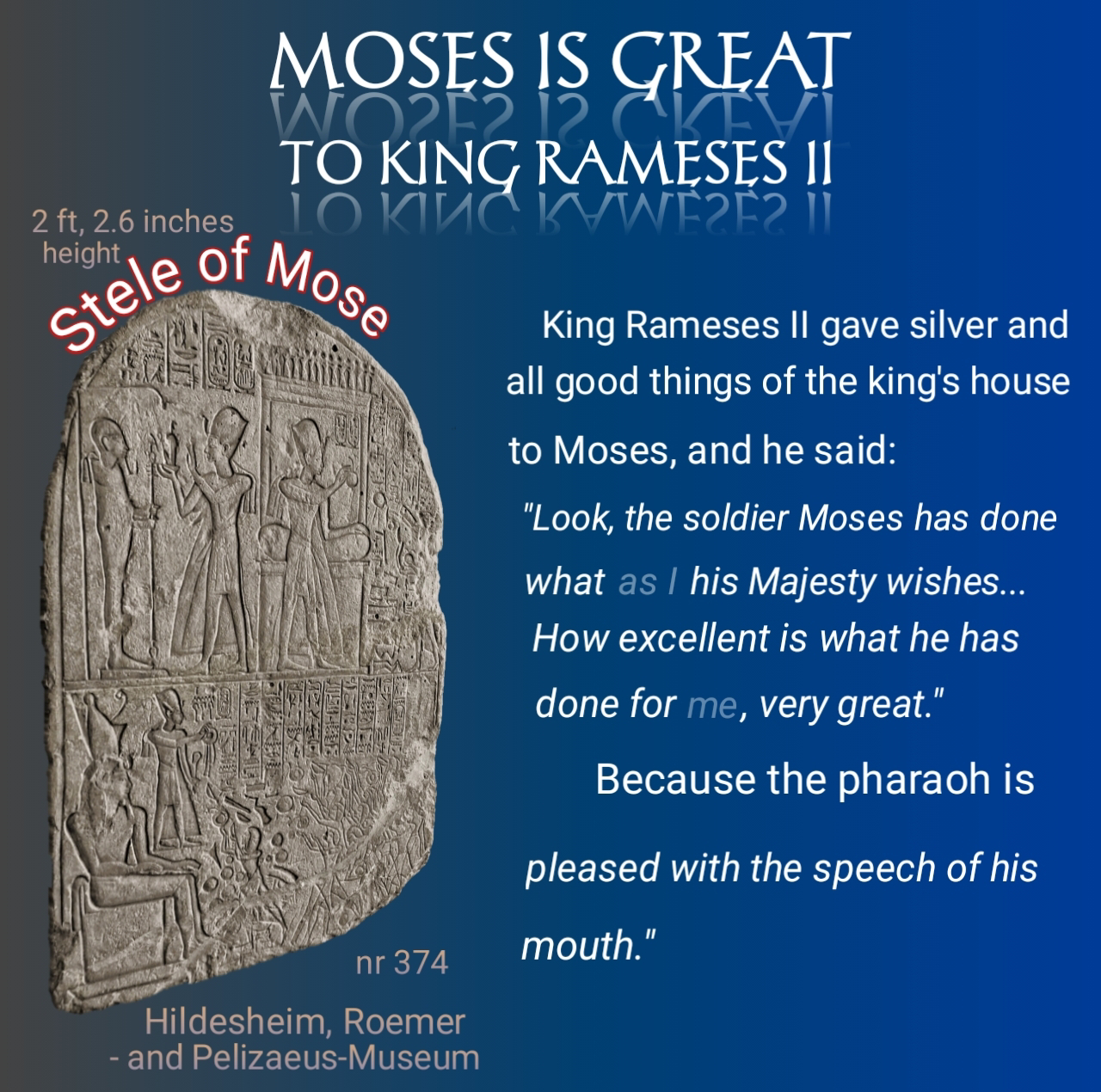
From king Rameses II, Moses had received silver & all good things from the king's house, and this event is officially reported on The Stele of Mose, where an army was celebrating Moses.

Moses reported it too in this way:

"Speak now in the ears of the people, and let every man borrow of his neighbour, and every woman of her neighbour, jewels of 

silver,

 and jewels of 

gold.

 And YHWH gave the people favor in the sight of the Egyptians. Moreover the 

man Moses was very great

in the land of Egypt, in the sight of Pharaoh's servants, and in the sight of the people." -Exodus 11:2-3


Thus, both king Rameses II (1279-1213 BCE) and Exodus 11:2-3 corroborate each other in reporting that Moses was great on the sight of the Egyptian people around 1230 or 1229 BCE.

Rameses II gave silver to Moses, and likely he gave the gold scarab of his father (Seti I) as the possible highest token of permission to travel abroad.
Clay scarabs (commemorative of Thutmose III) released in 1229 BCE were also given by king Rameses II to the people of Yahweh, probably effective as a military token only as long as they would not fight against Egypt.
The gold token (Seti I's scarab) was likely encharged by Moses to Joshua when he announced him as his successor. That gold scarab found its way to Jezreel, the territory of Joshua's tribe, and after 3 thousand years archaeologists discovered it together with a coffin.


According to Exodus 12:36 Moses - by the descendants of Israel - plundered Egypt. Moses did not give the reason why he asked the Hebrews to plunder Egypt with gold, silver, and other valuable things, likely after king Rameses II permitted him to ask any thing from the pharaoh's house, which might have resulted to looting in the temples.

King Setnakhte, the enemy of Yar-su (Moses) & Queen Tausert, revealed the reason why Yar-su plundered silver & gold from the temples of Egypt.


"... The troublemakers before him, after the fear  [of Setnakhte] had taken their hearts, they fled away like flocks of small birds with a falcon behind them, leaving behind 

gold,

 silver

 and  [... precious materials in] ta-Mery [Egypt]. They had those paid to the Asiatics of the leaders of Egypt to attract them as combatants. Their plans failed and their promises were stranded..." -Setnakhte, Elephantine stela, line 9

According to king Setnakhte's official report, Yar-su's troops were planning to use those gold & silver as a pay to attract Egypt's leaders in Syria-Palestine to be combatants against Egypt. 
The Egyptian 19th dynasty (1290-1189 BCE) royal scribe Ipuwer gives details about this plundering, saying:

"III. Indeed, the foreign barbarians came to deserted land, destroyed nomes. 

No Egyptians anywhere when men arrived.

Indeed, maidservants strung on their necks

 gold

 and lapis lazuli, 

silver

 and turquoise, carnelian and amethyst, Ibhet-stone...

[....]


Indeed, the builders [have become] cultivators, and those who were in the sacred bark are now yoked [to it]. None shall indeed sail northward to 

Byblos today;

what shall we do for cedar trees for our mummies, and with the produce of which priests are buried and with the oil of which [chiefs] are embalmed as far as

 Keftiu [Caphtor]?

 They come no more;

 gold is lacking

 [. . .] and materials for every kind of craft have come to an end. The [wealth] of the palace is despoiled...

Civil strife is impending without taxes to Upper Egypt's Elephantine and Thinis. Treasury is useless without revenues, as the palace's profit comes from craftsmen, that are lacking grain, charcoal, irtyw-fruit, m'w-wood, nwt-wood, and brushwood. Happy indeed is the heart of the king when truth comes to him!
What we can do if all is ruined as every foreign land is our fate and happiness?
 
Indeed, no laughter is made; instead groaning that is throughout the land, mingled with complaints.

IV. Indeed, every dead person is as a well-born man. Those who were Egyptians [have become] foreigners and are thrust aside.

[....]

Indeed, that has perished which yesterday was seen, and the land is left over to its weakness like the cutting of flax.

Indeed, the Delta in its entirety will not be hidden, and Lower Egypt puts trust in trodden roads. What can one do? No [secrets] exist anywhere, and men say: "Perdition to the secret place!" Behold, it is in the hands of those who do not know it like those who know it. The 

desert dwellers

are skilled in the crafts of the Delta.

[....]

Indeed, all female slaves are free with their tongues, and when their mistress speaks, it is irksome to the maidservants.

Indeed, trees are felled and branches are stripped off.

V.

[....]

Indeed, magnates are hungry and perishing, followers are followed [. . .] because of complaints.

Indeed, the hot-tempered man says: "If I knew where God is, then I would serve Him."

[....]

Indeed, runners are fighting over the spoil [of] the robber, and all his property is carried off.

Indeed, all animals, their hearts weep; cattle moan because of the state of the land.

Indeed, the children of princes are dashed against walls, and the children of the neck are laid out on the high ground. Khnum groans because of his weariness.

Indeed, terror kills; the frightened man opposes what is done against your enemies. Moreover, the few are pleased, while the rest are [not well]. Is it by following the crocodile and cleaving it asunder? Is it by slaying the lion roasted on the fire? [Is it] by sprinkling for Ptah and taking [. . .]? Why do you give to him? There is no reaching him. It is misery which you give to him.

Indeed, slaves . . . throughout the land, and the strong man sends to everyone; a man strikes his maternal brother. What is it that has been done? I speak to a ruined man.

Indeed, the ways are [opened], the roads are watched; men sit in the bushes until the benighted traveler comes in order to 

plunder

his burden, and what is upon him is taken away. He is belabored with blows of a stick and murdered.

Indeed, that has perished which yesterday was seen, and the land is left over to its weakness like the cutting of flax, commoners coming and going in dissolution [. . .].

VI. Would that there were an end of men, without conception, without birth! Then would the land be quiet from noise and tumult be no more.

[....]

Indeed, everywhere barley has perished and men are stripped of clothes, spice, and oil; everyone says: "There is none." The storehouse is empty and its keeper is stretched on the ground; a happy state of affairs! . . .
[....]

Indeed, the writings of the scribes of the cadaster are destroyed, and the corn of Egypt is common property.

Indeed, the laws of the council chamber are thrown out; indeed, men walk on them in public places, and 

poor men

break them up in the streets.

Indeed, the 

poor man

has attained to the state of the Nine Gods, and the erstwhile procedure of the House of the Thirty is divulged.

Indeed, the great council-chamber is a popular resort, and 

poor men

 come and go to the Great Mansions.

[....]

Indeed, those who were in the place of embalmment are laid out on the high ground, and the secrets of the embalmers are thrown down because of it.

VII. Behold, the fire has gone up on high, and its burning goes forth against the enemies of the land.

Behold, things have been done which have not happened for a long time past; the king has been deposed by the rabble.

[....]

Behold, it has befallen that the land has been deprived of the kingship by a 

few lawless men.

Behold, men have fallen into rebellion against the Uraeus, the [. . .] of Re, even she who makes the Two Lands content.

Behold, the secret of the land whose limits were unknown is divulged, and the Residence is thrown down in a moment.

Behold, Egypt is fallen to pouring of water, and 

he who poured water

on the ground has carried off the strong man in misery." - Ipuwer, III-VII

King Setnakhte summarized it by saying that the "land was in turmoil, Egypt had fallen into neglect of God" because all Egypt's temples were closed and no offering were prepared to enter the warehouses (Elephantine stela, lines 4,8). He also reported that Amon's high priest Bakenkhonsu had seen the images of gods & ancestors were fractured & fallen. 
King Rameses III reasoned out that Yar-su (Moses) did not recognize Egyptian gods as superior than humans & influenced people in the land under the dominion of the pharaoh to do not give offerings to the temples. According to Rameses III, Yarsu (Moses) made this practice since the time of Rameses the Great (1230 BCE) till the time of Queen Tausert (1189 BCE). 
Egyptian priest Manetho reported that Moses was from the lineage of priests in Heliopolis (On), which is correct because Joseph the Dreamer became a priest in Heliopolis. He translated Moses' Egyptian name "Yah-Mesu" aka "Yarsu" into "Osarsu" (Hellenized "Osarsiph").

In the 3rd century BCE Egyptian official history, Manetho (fl. c.286 - c.240 BCE) wrote:

"...when these [shepherds] were gotten into Avaris [Hwt-w'rt],
... they appointed themselves a ruler out of the priests of Heliopolis, whose name was

Osarsiph

and they took their oaths that they would be obedient to him in all things. He then, in the first place, made this law for them, that they should neither worship the Egyptian gods, nor should abstain from any one of those sacred animals which they have in the highest esteem, but kill and destroy them all; that they should join themselves to nobody but to those that were of this confederacy. When he had made such laws as these, and many more such as we're mainly opposite to  the customs of the Egyptians,..." (Aegyptiaca, preserved in Against Apion, book 1, section 26)

Manetho used the other description for Osiris, which is "yah" that for Egyptian language means "moon," which was referring to the other aspect of Osiris. 

"It was also reported that the priest, who ordained their polity and their laws, was by birth of Heliopolis, and his name Osarsiph, from Osyris, who was the god of Heliopolis; but that when he was gone over to these people, his name was changed, and he was called Moses."
 - Manetho, Aegyptiaca (preserved in Against Apion 1.28)

Manetho was more prank than Rameses III and reported that Moses... "first ordained that they should neither worship the gods, nor abstain from those animals that were worshipped by the Egyptians, but should kill and eat them all..."  

Moses ordered that on their Passover festival Hebrews must eat lambs, which were Egyptian considered physical manifestation of god Amon and an abomination to be eaten.
King Setnakhte called these "poor men" as

"nn nj sty.w" ("these dirty [men]"), 

a possible pun of word for "dusty" ('Apiru) people of Negev (south Judah) and for their sacrilegious activities to abandon Egyptian temples, as 

"sty"

is Egyptian for "dirty, messy," and with plural marker 

"-w

it may refer to the desert men of Negev, as archaelogically evidenced that the troops of Yar-su (Moses) destroyed Egyptian idols in Timna Valley, Edom in 1190 BCE. 


Not only in Ipuwer's report or archaeological findings, but also in pharaoh's official document  that the said troops had made the destruction are reported. King Setnakhte in 1186 BCE mentioned that Amon's high priest Bakenkhonsu

"...had seen the images of the highly praises and the images of the ancestors, the images of the noble kings, have fallen into a state of broken in the court of the gates of the court of the temple [of Karnak], by the hands of poor people fell on their fronts."

The report of this quartz stela corroborates what Ipuwer was complaining.

And king Rameses III (1186-1155 ) have summarized what had happened from the latter part of the reign of king Rameses II (1230 BCE) till Queen Tausert's last year (1189 BCE), which was the 1st year of king Setnakhte, as follows:

"The land belonging to Egypt was abandoned abroad, and disloyalty was in every man because they had no chief-mouth for many years at the start [Rameses II] until the time of others [Merneptah & Seti II] when the land belonging to Egypt was formerly under [our] mayors and city-rulers; one [Amenmesse] was killed, his successor [Siptah] was a dignitary of wretches.  Another [Queen Tausert] after him was in empty years, when 

Su,

 a Kharu [of Seir],

with them acted as outsider

 GREAT [chief],

 making the entire land serving him alone, and he joined his dependents in 

PLUNDERING

 their properties, and he treated gods as just like humans, that no man was presenting offerings inside the temple." - King Rameses III, Papyrus Harris I, 75.3-6, published by king Rameses IV on April 9th, 1155 BCE

The land abroad that was formerly under the influence of Egypt was all serving Yar-su (Moses) alone. Ipuwer gives the hints: Byblos and Caphtor, were now under the man who made the pharaoh ruined.

In the Bible, it is reported that during the exodus of Israel YHWH freed Peleset (Philistines) from Caphtor, and it's likely by Moses.

"Are ye not as children of the Kushiyim [Kushites] unto me, O descendants of Israel? says YHWH. Have not I brought up Israel out of the land of Egypt? and the Philistines from Caphtor, and Aram from Kir?" - Amos 9:7

Caphtor is an island from where Philistines were sailing to nearby Tyre & Sidon.

"Because of the day that comes to plunder all the Philistines, and to cut off from Tyre and Zidon every helper that remains: for YHWH will spoil the Philistines, the remnant of the
 
iy-Kaptor
[island of Caphtor]." -Jeremiah 47:4


King Rameses II (1279-1213 BCE) captured these men from Cyprus, and identified them as Caphtorim & men of Alashiya. These men from Cyprus island tried to penetrate Egypt, but the pharaoh did not permit them.
 
Moses allowed them to dwell in Gaza, probably as a buffer against non-members of their confederation. This was how YHWH saved Philistine ancestors (known "Caphtorim" unto Moses).

"Then we turned, and took our journey into the wilderness by the way of the reed's sea, as YHWH spoke unto me: and we compassed Mt. Seir many days. 
And when you come nigh over against the descendants of Ammon, distress them not, nor meddle with them: for I will not give you of the land of the children of Ammon any possession... And the Avims [Gueans] which dwelt in Hazerim, even unto Azzah [Gaza], the 

Caphtorims,

 who came forth out of Caphtor, destroyed them, and dwelt in their stead." -Deuteronomy 2:1,19,23

This gives clarity to the report of Ipuwer why Egyptians could not sail to Byblos as far as Caphtor. Because YHWH was freeing Philistines from Caphtor in Cyprus island during exodus (known "Late Bronze Age Collapse" in history) as Moses was active there in Asher, later known Phoenicia. 

Balaam Ben-Beor, in 1190 BCE, revealed a military secret describing that a back up of Israel to deal the Asshurites to save Kenites (family of priest Jethro Reuel) was a fleet of ships coming from Kittim (Kition) or Cyprus.

"...and Israel shall do valiantly. 
And 

ships

 shall come from the coast of Khittim, and shall afflict Asshur..." -Numbers 24:18,24

In the Battle of Kishon in 1208 BCE, prophetess Deborah revealed that the sailors were men of Asher & Dan, who were also identified by king Rameses III as Weshesh and Denyen, respectively.

"... and why did 

Dan

 remain in ships? Asher continued on the seas, and abode in his breaches. The kings came and fought, then fought the kings of Canaan in Taanach by the waters of Megiddo; they took no gain of money. They fought from heaven; the stars in their courses fought against Sisera. 
The river of Kishon swept them away, that Kedumim river, the river Kishon. O my soul, you have trodden down strength. 
Blessed above women shall Jael the wife of Heber the Kenite be, blessed shall she be above women in the tent." - Judges 5:17,19-21,24

The incident of the defeat of Qishon of Jabin to the Band of Deborah is officially discernable from the Great Asiatic List 23.21 of king Rameses II (1279-1213) and Topographical list 27.85 of king Rameses III (1186-1155 BCE). Qishon and Kedumim were both mentioned by king Rameses II (1270-1213 BCE). 
 
The Battle of Kishon took place in 1208 BCE and was also reported by king Merneptah when the disturbances came to his ears, particularly the problem that the wandering no permanent Israel of many men & women was causing in the border of Egypt in Seir (Kharu) and Yenoam near Rukkath, and the plunder that the Canaanites had done.

Year 2 of Setnakhte, who started to revolt against pharaoh Tausert in 1190 BCE, when Moses died on circa 24th February 1189 BCE and a few weeks, around March 10 more or less, Queen Tausert died, too, the mayors and officers abroad who were sympathetic to Egypt (that is to traditionalists), went to Setnakhte and greeted him on 22nd March, 1189 BCE, saying about the death of these two major enemies, saying:

"Your heart is joyful, Lord of this country!
That's what the [Egyptian] god foretold
happened!

Your enemies, they are no longer on Earth."
- Elephantine stela, line 15 (official report of king Setnakhte).

If king Rameses II deliberately erased the record about Mohy, the general behind the successes of his father (Seti I), and altered the wordings on the Stele of Mose, king Rameses III,on the other hand, did not include the names of Siptah and Queen Tausert from the list of Egyptian historical pharaohs.


The army that was on Queen Tausert's side was now leaning toward to Setnakhte.


"There is no power of an army or chariots
except that of your father Seth!"

02 June, 2022

CHUSHANRISHATHAIM


Changing good name into bad one, particularly for the enemy, was a known practice during the Late Bronze Age Collapse.
For example, the scribe of king Rameses III (1155 BCE) changed the name of

 "Meryra" ("Beloved of Re")

 into 

"Mesedsura" ("Re hates him")

after the failed assassination to the pharaoh.

This could be also why "Su" was given an infamous name "Yar-su" ("Plunderer [of authority] or "He made himself") from the likely original name "Yah-Mesu" (Moses born of Yah).

This was also a practice among Hebrews (e.g. for Mephiboseth, Jezebel, Nebuchadnezzar, and so on).


During the time of Joshua (1248-1138 BCE), the contemporary of Caleb, the uncle of Othniel, king Rameses II (1279-1213 BCE) identified a certain

Cushan-ra-im ("q-s-n-r-m")

in his topographic list 23, #13, in Great Temple of Amon at Karnak. King Rameses II did not recognize Cushan-ra-im (Qusanaruma) as a state, town, or permanent territory. 
Later, when Rameses III (1186-1155 BCE) reigned, this same 

Cushan-ra-im (Qusanarama)

was written on Great Asiatic List 27, #89 in Great Temple at Medinet Habu with the hieroglyphic description of being a state, town or permanent territory. Hebrews during Othniel's time (fl.1185-1144 BCE) likely renamed this Cushan-ra-im as

Chushan-risathaim
("man of Kush, who has twofold crime"),

who from Aram-Naharaim (Mesopotamia)  subdued Hebrews in Sidon or Lebanon in 1191 BCE. 

His name suggests that he was from Kush. This "Kush" is mentioned in Genesis 2:13 where river Gozan (Gihon) flows and which is described in Akhenaten's time (1334 BCE) to be near Naharina (Mitanni). 

The strong hand of the king took the land of Naharima, & the land of Kush,...” -Abdiheba, EA 288, lines 1-66 

In the Bible, it's clear that Cushanrishathaim was a king of Aram Naharim, thus corroborating that he came from Kush. Aram was a place surrounding Damascus. That Kushites (Kashites) were known to Jerusalemites as evil & committing crime is not a surprising thing. Even a general of Jerusalem reported to Akhenaten (1350-1334 BCE):

 "With regard to the Kashites, may the king make inquiry of the commissioners.Though the house is well fortified, they attempted a very serious crime.
 And please make the Kašites responsible for the evil deed. I was almost killed by the Kashites in my own house. May the king make an inquiry in their regard." - Abdikheba, EA 287, lines 33-37, 71-75

It is expected that Cushan-ra-im could be aliased as "Kushite with twofold crime" as Kashites prior him were known to Jerusalemites as evil or criminals.

Othniel, the nephew of Caleb, prevailed over him in 1185 or 1184 BCE as expectedly by this time he was very old. And it took place during the 2nd year of king Meli-Shipak ["Servant of Moon god"] (1186-1172 BCE) of Karduniash.

In circa 1185 BCE, hordes of enemies sacked the city of Emar in Aram (northern Syria), and a legal document dated to the 2nd year of Meli-Shipak (Legal text Msk. 73273) was found on the floor in a private house there. The sanctuaries of Baal and possibly of Astarte were destroyed, too. 
 (Daniel Arnaud, Les textes d'Emar et la chronologie de la fin du Bronze Recent, Syria, vol. 52, pp. 88-89, 1975). 


Emar was a satellite of Carchemish, hence may be the reason why king Rameses III called it Carchemish in 1179 BCE when describing it as one of the destroyed cities by the confederation of Peleset, Weshesh (Asherites), Denyen (Danites), Shakares (Issacharites), and Tjekru (Dor), when this confederation destroyed Amurru or Lebanon.

Kashites this time (1185/1184 BCE) were not ready, but Othniel prevailed over Cushanrishathaim of Aram.

The hieroglyphic records of the two pharaohs suggest that Cushan-ra-im at the beginning, that is, during king Rameses the Great's time (1279-1213 BCE), was just residing at a certain area near Damascus, but in 1185 BCE he had his own military territory coincided with the military defensive move of Othniel.

"Now these are the nations which YHWH left,... Namely, 5 sarnê of the Philistines, and all the Canaanites, and the 

Sidonians,

 and the Hivites that dwelt in Mt. Lebanon, from Mt. Baalhermon unto the entering in of Hamath. ...to know whether they would hearken unto the commandments of YHWH, which He commanded their fathers by the hand of Moses. 
And they...gave their daughters to their sons, and served their gods. And... did evil in the sight of YHWH, and forgot YHWH their God, and served Baalim and the Asheroth [groves]. Therefore ...He sold them into the hand of 

Chushanrishathaim king of Aram Naharim: 

and the descendants of Israel served Chushanrishathaim 8 years. And when the descendants of Israel cried unto YHWH, YHWH raised up ...Othniel the son of Kenaz, Caleb's younger brother. And the Breath of YHWH came upon him, and he judged Israel, and went out to war: and YHWH delivered Chushanrishathaim king of Aram into his hand; and his hand prevailed against Chushanrishathaim. 
And the land had rest 40 years. And Othniel the son of Kenaz died." -Judges 3:1,3,4,6-11

In this chapter we can discover that Caleb (contemporary of Joshua), his nephew Othniel, and king Chushanrishathaim (died after 1185 BCE) lived during the time when 5 seren (leaders) of Philistines had entered Sidon, Lebanon, Hermon, Hamath, & Canaan, and that was when Rameses III (1186-1155) was reigning in Egypt. In 1184 BCE king Rameses III reported the presence of Peleset (Philistines) and Tjekru (Dor).
During the exodus of Israel, YHWH (likely by Moses) 

"... brought up... out... Philistines from Caphtor,..." - Amos 9:7 

Thus, the secret passage of hundreds of hundreds of Peleset (Philistines) from 1190 to 1189 BCE until king Rameses III discovered it in 1184 BCE was not a hard thing to think.

According to the report of Judges, Hebrews this time married those Sidonians, Philistines, Hittites, Canaanites, and Hivites (Guaeans) and they gave their daughters to their sons and worshipped their Baal & Asheroth (idol groves). This gives us an idea that there were Sidonians, Guaeans (of Cilicia), (Peleset/ancestors of Philistines), and Shasu tribes who intermarried with the Hebrews, particularly with Asherites (of Phoenicia), Danites (of Laish, Ekron, Joffa), and Issacharites (of Dor & Issachar). 

Archaeologically & historically this was the time when king Rameses III officially reported that tens of thousand of these Peleset (Philistines ancestors), Denye (Danites), Weshesh (Asherites), Shakaresh (Issacharites), and Tjekru (Dor) were trying to journey in Syria-Palestine and later fought the pharaoh.

Othniel was the man who led to fought City of Sepher after Caleb challenged all men that he would let marry his daughter Achsah to a man who could defeat Debir in circa 1184 BCE.

Caleb was more or less 85 years old when this happened more than two decades before the 1st celebration of Jubilee (Numbers 36:4). The year zero of historical Israelite jubilee was in 1210 BCE when there was a great famine & terrible drought around Mediterranean.


"And Caleb said, He who smits Kirjathsepher, and takes it, to him will I give Achsah my daughter to wife. 
And Othniel the son of Kenaz, the brother of Caleb, took it: and he gave him Achsah his daughter to wife." -Joshua 15:16-17

"Then the descendants of Judah came unto Joshua in Gilgal: and Caleb the son of Jephunneh the Kenezite said unto him, You know the thing that YHWH said unto Moses the man of God concerning me and you in Kadesh-barnea. 
Forty years old was I when Moses the servant of YHWH sent me from Kadesh-barnea to spy out the land; and I brought him word again as it was in mine heart. And now, behold, YHWH has kept me alive, as he said, these 45 years, even since YHWH spoke this word unto Moses, while the children of Israel wandered in the wilderness: and now, lo, I am this day 85 years old. Now therefore give me this mountain, whereof YHWH spoke in that day; for you heard in that day how the Anakims were there, and that the cities were great and fenced: if so be YHWH will be with me, then I shall be able to drive them out, as YHWH said. And Joshua blessed him, and gave unto Caleb the son of Jephunneh Hebron for an inheritance. And the name of Hebron before was Kirjatharba; which Arba was a great man among the Anakims. And the land had rest from war." -Joshua 14:6-7,10,12-13,15

It was in 1228 BCE when Moses sent Caleb as one of the scouts to spy Canaan. And after 45 years, in around 1184 BCE, Caleb was asking Joshua for Arba (Hebron). It was near this time that Othniel defeated Debir (Sepher).

Joshua 15:13-15,63

"And [Joshua] gave unto Caleb Ben-Jephunneh a part among the descendants of Judah, according to the commandment of YHWH to Joshua, even the city of Arba the founder of Anak [city], which is Hebron. And Caleb drove thence the three sons of Anak, 

Sheshai, 

and Ahiman, and Talmai, the descendants of Anak. And he went up thence to the inhabitants of Debir: and the name of Debir before was Kirjath-Sepher. As for the Jebusites the inhabitants of Jerusalem, the descendants of Judah could not drive them out: but the Jebusites dwell with the descendants of Judah at Jerusalem unto this day." -Joshua 15:13-15,63

The existence of Cushan-ra-im (Cushanrishathaim) as far as the official records of king Rameses the Great (1279-1213) and Rameses III (1186-1155 BCE) are concerned was during the time of the "Alliance [Qishon] of Jabin" and "Band [Qweshe'] of Deborah."
 This was also in the time of Joshua (1248-1138 BCE), the contemporary of Caleb, the uncle of Othniel (fl. 1185-1144 BCE).

It was Joshua (1248-1138 BCE), with the people of Yhw (Yahweh) who built the altar in Mt. Ebal according to the commandment of Moses.


"Then Joshua built an altar unto YHWH God of Israel in 

Mt. Ebal, 

As Moses the servant of YHWH commanded the descendants of Israel, as it is written in the book of the law of Moses, an 

altar

 of whole stones, over which no man has lift up any iron: and they offered thereon burnt offerings unto YHWH, and sacrificed peace offerings." -Joshua 8:30-31

29 May, 2022

BIBLICAL MOSES' EXODUS OF ISRAEL


That Moses wrote his journal or stories during the time of Rameses is evident in his usage of the toponym "Rameses" in the the writings that became the sources of information of "Genesis," "Exodus," & "Numbers."

The original sources of "Genesis," "Exodus," & "Numbers" were written during the time of Rameses.

Moses reported that...

"Joseph placed his father and his brothers, and gave them a possession in the land of Egypt, in the best of the land, in the 

land of Rameses,

 as Pharaoh had commanded." -Genesis 47:11

Goshen, during Moses' days, was located in the "land of Rameses." Or most likely Hebrews had tents in a particular area in Avaris, which was during Moses' time belonged to a region called "Rameses." 

King Seti I (1290-1279 BCE) started redeveloping Avaris, as his ancestor (king Set) was deified there when Hyksos lived in the city. The successor, Rameses II, continued the building projects, and had usurped and renamed them. Seti's palace was turned into a city with plenty of foods, military factories, arms, and resources. The pharaoh renamed it "Pi-Rameses Aa-nakhtu," which is the biblical "Raamses." Moses was confirmed about "treasure-city" or "store-city Raamses" by an Egyptian scribe, who described it.

"" I arrived at the Pi-Rameses [House of Ramesses], beloved of Amun and I found it extremely prosperous... life in the Residence is pleasant. Its fields abound with all good produce. Its canals are filled with fish and its marshlands with birds. Its plains are abundant with green pastures.. from the cultivated fields come fruit with the taste of honey, its granaries are filled with barley and wheat." -Pabasa the scribe


RAMESES OF THE BIBLE

In Papyrus Anastasi III 2:11-3:3, written in circa 1210 BCE, we can learn that the toponym "Rameses" was derived from the name of king Rameses the Great. The toponym "Rameses" was in use from  13th to 10th century BCE, and after that Egyptians renamed it back to " ḥw.t wꜥr.t " (hut-waret), which the Greek writers transliterated into Αὔαρις (Auaris), which is now spelled Avaris. Since then, the exact location of the capital city Rameses was unknown until it was dug again up in the 1970's.
During the time of the Judges the region in which it was also belonged was called Zoan. Tanis (biblical Hanes) & Raamses were included in Zoan (Numbers 13:22, Psalms 78:12,43,. Isaiah 30:4).

The granary of Avaris (Tell el-Dab'a) 2 kilometres to the south became incorporated with the capital city, Pi-Rameses (Qantir).

"Therefore they did set over them forced-labor masters to afflict them with their burdens. And they built for Pharaoh store-cities Pithom and Raamses." -Exodus 1:11


PITHOM OF RAMESES

The Polish-Slovak Archaeological Mission headed by Sławomir Rzepka and Jozef Hudec in cooperation with Institute of Archaeology, Polish Centre of Mediterranean Archaeology, Slovak Academy of Sciences, and Aigyptos Foundation confirmed Moses' report that the pharaoh who built "Raamses" had built also a store-city Pithom (Hebrized for "Per-Atum," "Per-Etham" or Pi-Tum - precinct city of god Atum).
Archaeologists found in Tel el-Retaba Rameses II's "Pithom" or temple of Atum, defense walls, garrison barracks, workshops, and granaries. This city was located in the middle of Wadi Tumilat, the stretch of a valley called Tjeku by the Egyptians.  
Later a pharaoh of Saite dynasty transferred the materials of Pithom from Tel el-Retaba to the eastern part of Wadi Tumilat probably as the water of the lake or river in the western region had dried up.
On 12 km (7.5 mi) to the east, in Maskutah, where materials of this city were transferred, was found by Prof. Edouard Naville in 1883 the inscription of Rameses II saying: "I built Pithom at the mouth of the East."

King Rameses II (1279-1213 BCE) has categorically stated that he built Pithom (at Wadi Tumilat).

In 1206 BCE an officer of a pharaoh said that the 'Pithom' and the pools/lake of Merneptah were both located in Tjeku (Succoth).

 Both history, archaeology, and Moses are accurately confirming the fact that the pharaoh of Rameses built Pithom in Wadi Tumilat.

Moses is accurate in describing Pithom as a store-city. He is also accurate in saying that its builders were Hebrews as the inhabitants of that city were descendants of Hyksos ('Foreign Kings'). This Pithom of king Rameses II was in Tell el-Retabeh in the midpart of Wadi Tumilat. The root of "Tumilat" could be "-Tum" (short form of "Atum") to mean land of Atum later understood as goddess Atum. This Pithom city was the first fortress in Tell el-Retabeh which was built by king Rameses II. 
Instead of the usual stones, its walls, 6 meters (18 ft) thick, were made of mud-bricks with straw. 

BRICKS OF STRAW TO BUILD PITHOM CITY

 Again Moses was right on his report about making bricks of straw to build the city for the pharaoh of Rameses.
The pharaoh ordered his masters to let workers search straw for their bricks after Moses asked him 3-day rest for the Hebrews.

"And Pharaoh commanded the same day the taskmasters of the people, and their officers, saying, Ye shall no more give the people straw to make brick, as heretofore: let them go and gather straw for themselves." - Exodus 5:6-7

Inscription written in that era verified that brickmakers were tasked a daily quota when an Egyptian officer wrote in Papyrus Anastasi III:

"Likewise, people are making bricks... they are making their quota of bricks daily.

Moses (1309-1189 BCE) was accurate in reporting that in his era there was a shortage of straw for making bricks. 


An Egyptian overseer wrote in Papyrus Anastasi IV a complaint: 

" I am residing at Qenquen-en-ta, without provisions, and neither men to make bricks nor straw are in the region."

Archaeological findings in Pithom in Tel el-Retabeh could also show us that some of the bricks are lacking of enough straw, confirming the report of Moses.

WORKERS OF PITHOM

Evidence shows few child burials in it, which indicate that the workers were relatives of Hyksos. It's not a surprising thing since Hyksos became developers of Avaris during the days of Abraham (1738-1563 BCE), and between 17th & 16th century BCE, Hyksos built their houses and cemetery in Tel el-Retabeh. 
 It was king Ahmose I (1550 BCE) who defeated Hyksos, and forced the Hyksos of Tel el-Retabeh to soon evacuate, thereby letting Egyptians to dwell in Tel el-Retabeh. 
But the Egyptians abandoned it around 1449 BCE, coincided with the arrival of the family of Jacob in Egypt.
 
During the time of Rameses II the relatives of these Hyksos lived again in Tel el-Retabeh until they abandoned it (1229 BCE). It was Rameses II who first made a fortress in Tel el-Retabeh. In Egyptian hieroglyphics, Tjeku (Succoth) is described as a foreign land, as Hebrews, particularly those related to the Hyksos, were living in it in the 14th century BCE.


King Rameses II was proud to officially record that he had subdued people of Yahweh in Makhtesh Ramon (known anciently Kushu or Kushan in Midian land in Negev, south Judah) by inscribing his own name together with the "Shasu of the Land of Yahweh" to a pillar erected at Amarah West temple.

Simultaneous building projects of Rameses II (1279-1213) required a lot of workers, including foriegners, from north to south, west to east.

Amenmone was reminded to

"Give food rations to the soldiers and the Apiru-laborers who are drawing water from the well of Pre of Rameses II, L.p.h., south of Ai-gy-ptos" (Leiden Papyrus 349),
and  

"Give food rations to the people of the army and to the 'Apiru who are dragging stones for the great pylon [temple gate of Rameses the Great]" (Leiden Papyrus 348).

According to the report of Terru (Terah) to king Zimrilim, Habiru (Hapiru/ Apiru) were citizens living in the country of Terru, and sooner in around 1664 BCE Abram, the son of Terah, was called Hebrew. Hence the line of Abram down to Moses was called Hebrew. Moses reported that these Hebrews were mixed multitude (Exodus 12:37-38, Numbers 11:21). 
The Leiden Papyrus 348 & 349 confirm that there were Apiru (Hapiru, Habiru, Hebrews) who were under forced labor during the time when king Rameses II was building temples in Ai-gyp-tos and likely in Pi-Rameses and Pithom.


At 20s Moses visited his brothers. Two years or so, Seti I, "the king of Egypt died" in 1279 BCE.


"And it came to pass in those days, when Moses 

וַיִּגְדַּ֤ל
[wa-yighdal/
was grown], 

that he went out unto his brothers, and looked on their burdens ...
And it came to pass in process of time, that the

 king of Egypt died

and the descendants of Israel sighed by reason of the bondage, and they cried, and their cry came up unto God by reason of the bondage." -Exodus 2:11,23

Yighdal, or its root "gadal," is a period from teenager to 20's, the age that a man could marry a woman for procreation reason as it is understood in Genesis 38:11,14 & Ruth 1:13.
At 20's Moses heard the cry of his countrymen.

Why they cried?

Because the pharaoh ignited a series of much hardwork building projects started in 1275 BCE when he built a store-city, which later named "Pi-Rameses," to manufacture 1000 weapons, 250 chariots, and 700 shields in a week. 
The granary of Avaris (Tel el-Dab'a), 2 km (1.25 miles) east, became its extension.

It could be during this period of building projects that king Rameses II commended Moses, a soldier that was highly praised for his service. This Moses could be the same person Mohy, who was behind the military successes of king Seti I. 

The first Christian deacon martyr, Stephen, estimated that at the age of 40 Moses committed a murder to defend his countryman (Acts 7:22-24). This could be in circa 1269 BCE. 

A scribe in the Egyptian 19th dynasty has reported:

"Behold, a man is slain beside his brother, who runs away and abandons him to save his own skin." - Admonitions of Ipuwer, 19


Scribe Ipuwer of the Egyptian 19th dynasty (1290-1189 BCE), who wrote Admonitions of Ipuwer from around 1230-1170 BCE, is describing that during the latter part of the reign of a strong man (pharaoh), a man (Moses) who poured water on the ground made that pharaoh in ruin. The same complain (ruining) is written by king Rameses III (1186-1155) about Yar-su (Moses). Corroborating Ipuwer & Rameses III was the Egyptian priest Manetho who directly identified Moses as the man who led Shepherds between 1209 & 1198 BCE.

 "Northern Egypt weeps; the king's storehouse is the common property of everyone, and the entire palace is without its revenues. To it belong emmer and barley, fowl and fish; to it belong white cloth and fine linen, copper and oil; to it belong carpet and mat, [. . .] flowers and wheat-sheaf and all good revenues . . ." - Ipuwer, 10

And the complain of Ipuwer about what the pharaoh had done during the latter regnal years:

"all herds. It means that ignorance of it is what is pleasing to the heart. You have done what was good in their hearts and you have nourished the people with it. They cover their faces through fear of the morrow.
That is how a man grows old before he dies, while his son is a lad of understanding; he does 

not open [his] mouth to speak

to you, ..." - Ipuwer, 16

King Rameses III (1186-1155) reported, too, that king Rameses II (1230 BCE) kept quiet about the plundering that Yar-su (Moses) was doing:


"The land belonging to Egypt was abandoned abroad, and disloyalty was in every man because they had 

no chief mouth

 for many years at the start [Rameses II] until the time of others [Merneptah & Seti II] ... one [Amenmeses] was killed, his successor [Siptah] was a dignitary of wretches. Another [Queen Tausert] after him was in empty years, when 

Su [Moses],
a Kharu [of Seir]

with them acted as outsider chief, making the entire land serving him alone, and joined his dependents in 

plundering

their properties, and treated gods just like humans, that man was not presenting offerings inside the temple." - Papyrus Harris I, 75.3-6


A document known "The Stele of Mose" erected by king Rameses II confirmed what the pharaoh had done to please Moses & the army.


On the stele, king Rameses the Great is depicted coming from a temple & then posing on front of his own statue at Pi-Rameses (Qantir) in the presence of the whole army and telling them:

"Look, the soldier Moses has done what [as I ] his Majesty wishes... How excellent is what he has done for [me], very,very much." -Stele of Mose
The army shouted: "You [pharaoh] are like Re. ..We live from your sight."

They celebrate Moses, and in military garb were throwing pointed aprons & receiving gifts from Rameses II.

This stele erected by king Rameses II for Moses is a confirmation of Moses' report.

"Speak now in the ears of the people, and let every man borrow of his neighbor, and every woman of her neighbor, jewels of silver, and jewels of gold. 
And YHWH gave the people favor in the sight of the Egyptians. Moreover the

 man Moses was very great

 in the land of Egypt, in the sight of Pharaoh's servants, and in the sight of the people." -Exodus 11:2-3

Because of good reasoning, the pharaoh gave silver & all good things of the king's house to this senior officer, Moses.


"The King himself gives silver & all good things of the king's house," because the king is "pleased with the speech of his mouth". 
To the soldiers Rameses II says: "I wish you may see and do what His Majesty loves. How good is what he has done! Great, great!"

Why king Rameses II needed to give silver & all good things of the king's house to Moses & the soldiers who were celebrating Moses?

Because YHWH instructed Moses to ask valuable things from the Egyptians.

"And I will give this people favour in the sight of the Egyptians: and it shall come to pass, that, when ye go, ye shall not go empty" -Exodus 3:21

The pharaoh without knowledge of the exact dreadful day of the death of the firstborn sons in Rameses, was not ready just in case generals would leave Egypt.
 
The exodus was planned to be at midnight when there was a full moon.

THE FINAL PLAGUE 

Scribe Ipuwer (fl. 1230- c.1170 BCE) wrote a lot of plagues of the Late Bronze Age Collapse.

"Forsooth, gates, columns & walls are consumed by fire. 
Lower Egypt weeps. The entire palace is without its revenues. To it belong [by night] wheat & barley, geese & fish. Forsooth, grain has perished on every side.
Forsooth, that has perished which was yesterday seen. The land is left over to its weariness like the cutting of flax." - Ipuwer 2:10, 10:3-6, 6:3, 5:12

The pharaoh of Rameses, together with Egyptian people, were under shock, when their firstborn sons died.

"Forsooth, the children of princess are cast out in the streets. The prison is ruined. He who places his brother in the ground is everywhere. It is groaning throughout the land, mingled with lamentations" - Ipuwer 6:12,3, 2:13, 3:14


"And Moses wrote their journeys by the commandment of YHWH... And they departed from Rameses on the 15th day of the 1st month; on the day after the Passover the descendants of Israel went out with an high hand in the sight of all the Egyptians. 
For the Egyptians buried all their

 firstborn, 

which YHWH had smitten among them: upon their 

gods

also YHWH executed judgments. 
And the descendants of Israel removed from Rameses, and encamped at Succoth
And they left Succoth, and encamped at Etham in the edge of the wilderness. 
And they removed from Etham, and turned again unto Pihahiroth, which is before Baalzephon: and they pitched before Migdol. 
And they departed from before Pihahiroth, and passed through the midst of 

yam
[the sea]

into the wilderness, and went 3 days' journey in the wilderness of Etham ..." -Numbers 33:2-8

When this exodus took place?

Succoth, Baalzephon, Rameses, Pihahiroth, and Pithom [Per-Etham] are all toponyms from the 13th century BCE. 

Baalzephon is mentioned in Papyrus Sallier IV, 1:16 written in circa 1225 BCE, whereas 

Pihahirot, 
Rameses, 
Baal-[zephon], and 
yam tufy 

mentioned in Papyrus Anastasi III, 2:8-3:3 that was written in circa 1210 BCE. Both of these papyri are in the British Museum. Egyptian hieroglyphics describes 

Tjeku (Succoth)

 as a foreign land in Egypt (Wadi Tumilat). Papyrus Anastasi V, 19.2-20.6 reported that there was an enclosure-wall of Succoth and there was a Migdol of Seti I (1290-1279 BCE) in the western direction from the palace (which was in what later called Raamses). In 1206 BCE Inena reported in Papyrus Anastasi VI, 4.56 that there was 

Precinct-Etham (Pithom)

 in Succoth.
All of these extant documents prove that the report of Moses is pertaining to the 13th century BCE.
Rameses was a region, where Raamses city, Pithom, and yam suph (Reeds' Sea) belonged, derived its name from king Rameses II.

King Rameses II during his first heb sed festival in circa 1250 BCE was ritually transformed into an Egyptian god  when the firstborn son was Prince Ramesses B. Because of this, Prince Rameses junior had to sit on the throne to act as pharaoh, as his father (the real pharaoh) was functioning as an Egyptian god. 

"And all the firstborn in the land of Egypt shall die, from the Pharaoh's firstborn 
hayoseb [sitting]
al-kis'ow [upon his throne],
even unto the firstborn of the maidservant
asher [who is]
akhar [behind]
ha-rekhayim [the handmill]; and all the firstborn of beasts." -Exodus 11:5

It is clear in the report of Moses that the firstborn son (crown prince) was sitting on the throne of the pharaoh.
All the firstborn sons of Rameses the Great died before the pharaoh died, and he built the largest tomb in Egypt now known KV5 to accommodate all his children. One of them was Prince Ramesses B who had happened the firstborn son in 1229 BCE.

According to Moses the death of the firstborn son was a judgement of YHWH against the Egyptian gods, particularly to the king of Rameses.
 It was the regnal Year 50 of king Rameses the Great when prince Rameses junior died in 1229 BCE - when Moses was 80 years old. 
Hence Moses lived from 1309 to 1189 BCE.

"And Moses was 80 years old, and Aaron 83 years old, when they spoke unto Pharaoh." -Exodus 7:7

"And Moses was 120 years old when he died: his eye was not dim, nor his natural force abated." -Deuteronomy 34:7

ARAB ARABIA ARABAH

SAUDI ARABIA: the phrase " Saudi Arabia " was officially invented on 23 September AD 1932 by its founder, Abdulaziz b...